


City following protocol to get borer beetle infestation under control

Tasleem Gierdien
16 April 2025 | 8:28Over 6,000 affected trees have been identified in the Cape.
CapeTalk's John Maytham speaks to Bongani Zungu, Invasive Species Programme Manager for the City of Cape Town.
Listen below:
Some of Cape Town’s urban forests are infested with a tree-killing beetle, called the borer beetle - scientific name: Polyphagous Shot-Hole Borer (PSHB).
The beetle, which comes from Vietnam, works by burrowing into the tree and sucking all the nutrients and water out, thereby killing it.
The beetle arrived in Cape Town three years ago and since then, there has been a decline in the English oak trees, with thousands of trees having been affected in the Mother City alone.
To date, over 6,000 infested trees have been identified in the Cape.
Among these trees, there are highly susceptible reproductive host species such as Boxelder, Weeping Willow, and English Oak.
What to look out for and symptoms of infested trees:
-
Branch dieback – cracks on the branch; discoloured leaves; dry and leafless branches; branch break-off revealing webs of galleries filled with black fungus.
-
Gumming – blobs of goo coming out of the bark; oozing of liquid and gum from the beetle holes
-
Entry and exit holes – very small holes on the bark of the tree, the size of a sesame seed (2mm); shotgun-like scars developing around the holes.
-
Staining – brown or dark stains on the bark of the tree.
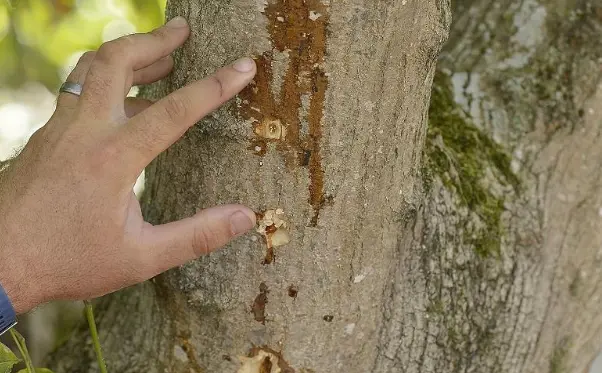
Borer beetle infested tree
How to report PSHB beetle sightings:
- Online, at capetown.gov.za/InvasiveSpecies.
- Call the City of Cape Town’s Invasive Species Unit on 021 444 2357, Monday to Friday, from 07:30 to 16:00.
- Send an email to: invasive.species@capetown.gov.za.
"As a City, we follow a protocol when we approach infested trees and our protocol is based on the readily available scientific information and experiences from other countries where these species have been reported... our protocol does not follow a blanket approach when it comes to the removal of trees, because we cannot be removing trees that don't show signs of the PSHB."
- Bongani Zungu, Invasive Species Programme Manager - City of Cape Town
"In terms of resistance, it has to be a long-term study... PSHB for us, is something that's relatively new, and the science keeps on changing because there's work being done in the background - and we keep adjusting our protocols on the readily available science, and at this stage, our approach has always been on trying to protect the non-infested trees by moving as quickly as we can in trying to remove the infested trees."
- Bongani Zungu, Invasive Species Programme Manager - City of Cape Town
While there are resistance methods available, these pesticide products are only for use in rural areas and exclude use in urban environments.
"We do not know of any product that's been approved for use on the control of PSHB at this stage... we are working closely with universities on this and we are certain that if there is any product that's been approved, we'll get that information and we'll have to go back and review protocols accordingly."
- Bongani Zungu, Invasive Species Programme Manager - City of Cape Town
RELATED:
Borer beetle sighted in Bellville! Residents encouraged to complete URGENT surveys
Cape Town's urban forests under attack from tree-killing beetle
Scroll up to the audio player to listen to the full conversation.
Get the whole picture 💡
Take a look at the topic timeline for all related articles.
Trending News
- 2 hours ago
Geordin Hill-Lewis elected as new DA federal leader
- 3 hours ago
Felix Masai and Lavinia Haitope claim victory at Two Oceans half marathon
- 6 hours ago
Former heavyweight king Fury outpoints Makhmudov, calls out Joshua
- 7 hours ago
The blue machine enters a new era: Steenhuisen and Zille Bow Out
- 8 hours ago
DA Federal Congress: Delegates gear up to elect new leadership
- 11/04, 08:00
DA Federal congress: Zille confident in new generation of leaders
- 11/04, 07:58
ANC yet to decide whether non-members can be recruited to stand as mayoral candidates
- 11/04, 06:27
Gwarube backs Geordin Hill-Lewis to become new DA leader
- 10/04, 16:07
Mbalula: SACP independent election bid is 'water under the bridge'
- 10/04, 14:05
Ramaphosa deflects as declassified IPID report details Phala Phala cover-up allegations
- 10/04, 13:37
South Africa marks 328 days without load shedding as Kusile reaches full capacity
- 10/04, 12:00
Judges Matter welcomes two new Constitutional Court judges


