Why greater adoption of GS1 standards is key to achieving Africa’s trade potential
Paula Luckhoff
15 April 2026 | 20:17GS1 SA, official supplier of barcodes in the country, explains why standards harmonisation is important for global trade, especially in Africa where adoption is still lagging behind.

Scanning a barcode in a grocery store. Pexels/iMin Technology
Did you know that an estimated 6-10 billion barcodes are scanned across the world every day?
GS1 South Africa - official supplier of barcodes in the country, emphasizes how important it is for trade that this standard is uniform, particularly on the African continent where countries are still lagging behind.
"GS1 is a neutral, global network that brings industries, government, academia, regulators, and associations together with collaborative platforms to develop solution-based standards that address the challenges of modern data exchange for each unique business sector."
At the GS1 Indaba 2026 just held on the East Rand in Gauteng, panelist Michael Sudarkasa said while Africa’s trade opportunity is real, it is trust that will determine if this opportunity is fully realised.
As cross-border trade grows, so does the need for stronger standards, clearer traceability and more confidence in the products moving through the value chain.
GS1 SA says the discussion highlighted that ‘Made in South Africa’ already carries weight in global markets, but sustaining that reputation requires systems that support quality, safety and transparency from upstream production through to the final product:
"As the conversation made clear, standards harmonisation is not a technical side issue. It is a practical enabler of regional competitiveness."
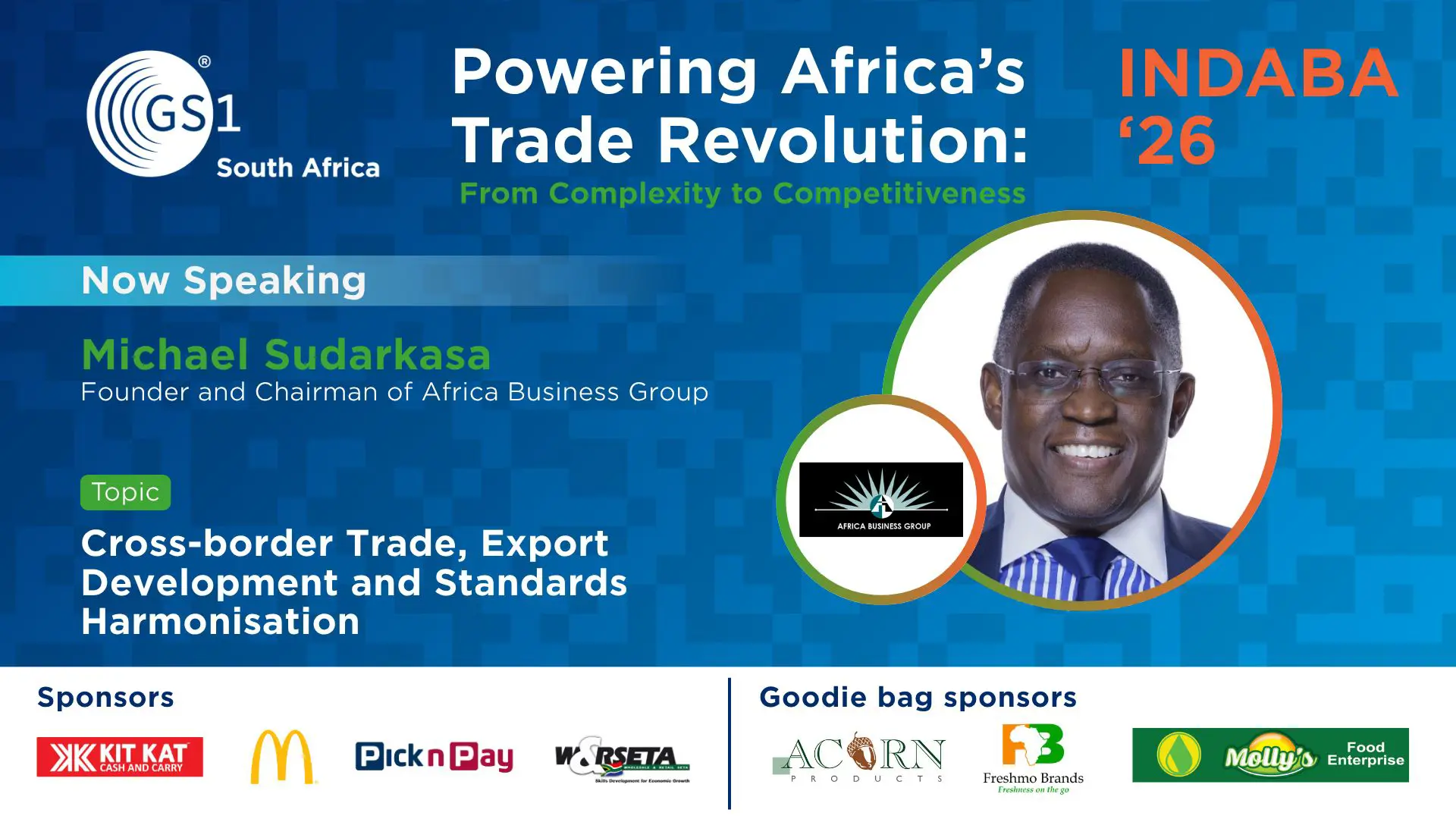
GS1 South Africa Indaba 2026 - LinkedIn
Company CEO Zinhle Tyikwe explains how barcodes are generated, and why they are so important.
"Whenever an individual comes and buys a barcode from us, we take the information about the product, about the brand owners, and about the location of where this product was produced. That ensures that, already, there is trusted information being captured, using a standard... So, when a retailer puts your product on its shelves, they can check the certifications which are already digitally captured for them."
Why GS1 SA says Africa's trade system is at a turning point is because so many countries on the continent still have different systems and follow different standards, Tyikwe says.
GS1 standard adoption is currently sitting at just over 30%, not even 25 countries, she explains.
"67% have not adopted it, which means they're not following the standard that South Africa is following. And why is it a global standard? Because the information is captured in the same way - here in SA, in the US, in Iraq... everywhere in the world where GS1 is present, which is 120 countries globally."
She uses the recent flurry of product recalls in South Africa as an illustration of how important it is that our own government mandates the use of the GS1 standard.
Scroll up to the audio player to listen to this enlightening conversation
Get the whole picture 💡
Take a look at the topic timeline for all related articles.
Trending News
- 5 hours ago
ANC removes Jeff Radebe as KZN convenor, appoints Mike Mabuyakhulu
- 8 hours ago
Julius Malema set to learn his fate after 8 years in the dock
- 9 hours ago
IN PICS | EFF supporters gather in KuGompo City to support Malema
- 10 hours ago
From ball picker to national champion: The resilient rise of Sthabile Mnyandu
- 11 hours ago
Major General Johan Booysen withdraws as witness from Nkabinde Commission
- 11 hours ago
Ramaphosa defends appointment of Roelf Meyer as SA ambassador to US
- 11 hours ago
Tshwane CEO Gareth Mnisi placed on precautionary suspension
- 11 hours ago
State in firearms discharge case describes Malema’s actions as 'barbaric'
- 12 hours ago
Shamila Batohi defends NPA progress on TRC cases at Khampepe inquiry
- 12 hours ago
Mkhwanazi accused of being 'untruthful' about recalling alleged torture of suspect
- 13 hours ago
Malema sentencing: Lawyer argues custodial sentence would be 'grossly unfair'
- 15 hours ago
LIVE | Julius Malema returns to court for sentencing