


Can City Power's EV pilot withstand a fragile grid?
Mandisa Ndlovu
16 April 2026 | 12:03Speaking to Our City News, the founder of the EV Association of South Africa, Martin McLaren, said the rollout was both meaningful and measured.

The newly-launched electric vehicle charging station at City Power's headquarters in Booysens, Johannesburg. The newly-launched electric vehicle charging station at City Power's headquarters in Booysens, Johannesburg. Picture: Supplied
Following City Power's launch of its first electric vehicle (EV) charging station, energy experts remain cautiously optimistic about its viability. While the EV Association of South Africa agrees that the move is necessary, they warn that its success hinges entirely on how effectively the City manages its existing electricity constraints.
Speaking to Our City News, the founder of the EV Association of South Africa, Martin McLaren, said the rollout was both meaningful and measured.
“It is a practical and symbolic first step, because it gives the City real operational experience and symbolic because it signals that municipalities do not have to wait for the private sector before starting the transition,” McLaren said.
The charging station, launched on Tuesday, 24 March at City Power’s Booysens head office, is the first phase of what the utility describes as a broader shift towards electric mobility. EVs, which run on electricity rather than petrol or diesel, are widely seen as part of the global transition to cleaner energy.
But in a city still grappling with fragile infrastructure, electricity losses and a history of power cuts, the question is not whether EVs are the future, but whether Johannesburg is ready for them.
City Power spokesperson Isaac Mangena framed the launch as deliberately cautious.
“This is a proof of concept. It allows us to test the technology, understand energy demand, build internal technical expertise, and develop a scalable model,” he said.
The pilot facility includes 20 charging points with fast and medium-charging capability, supported by a hybrid energy system combining solar power, battery storage and grid supply. The aim, according to City Power, is to introduce EV demand in a “controlled and sustainable manner”.
While national power utility Eskom has recently reported improved supply stability, Johannesburg’s municipal network continues to face its own pressures, including infrastructure theft, illegal connections and energy losses estimated at nearly a third of supply.
In that context, McLaren argues that EV adoption must be tightly managed.
“EV fleets are practical for controlled depot-based use, particularly where cities can integrate solar, batteries and off-peak charging. But this has to be treated as an infrastructure management project, not simply a vehicle purchase,” he said.
McLaren said that distinction is key. “Rolling out EVs is not just about buying new cars, it requires upgrading depots, managing peak demand, securing infrastructure and building technical capacity within the municipality.”
Phase One of City Power’s project, which cost about R14 million, includes not only charging stations but also a solar photovoltaic system, battery storage and software to manage charging loads.
The utility currently operates just one fully electric vehicle and 14 hybrids, with plans to expand gradually. The broader City of Johannesburg fleet, around 680 vehicles within City Power alone, will transition in phases, starting with high-usage categories where savings are most likely.
City Power estimates it could save between R29.7 million and R49.3 million annually, depending on how vehicles are financed. Over time, it also expects to significantly cut emissions by more than 52,000 tonnes of carbon dioxide a year.
But, as McLaren points out, those benefits are long-term.
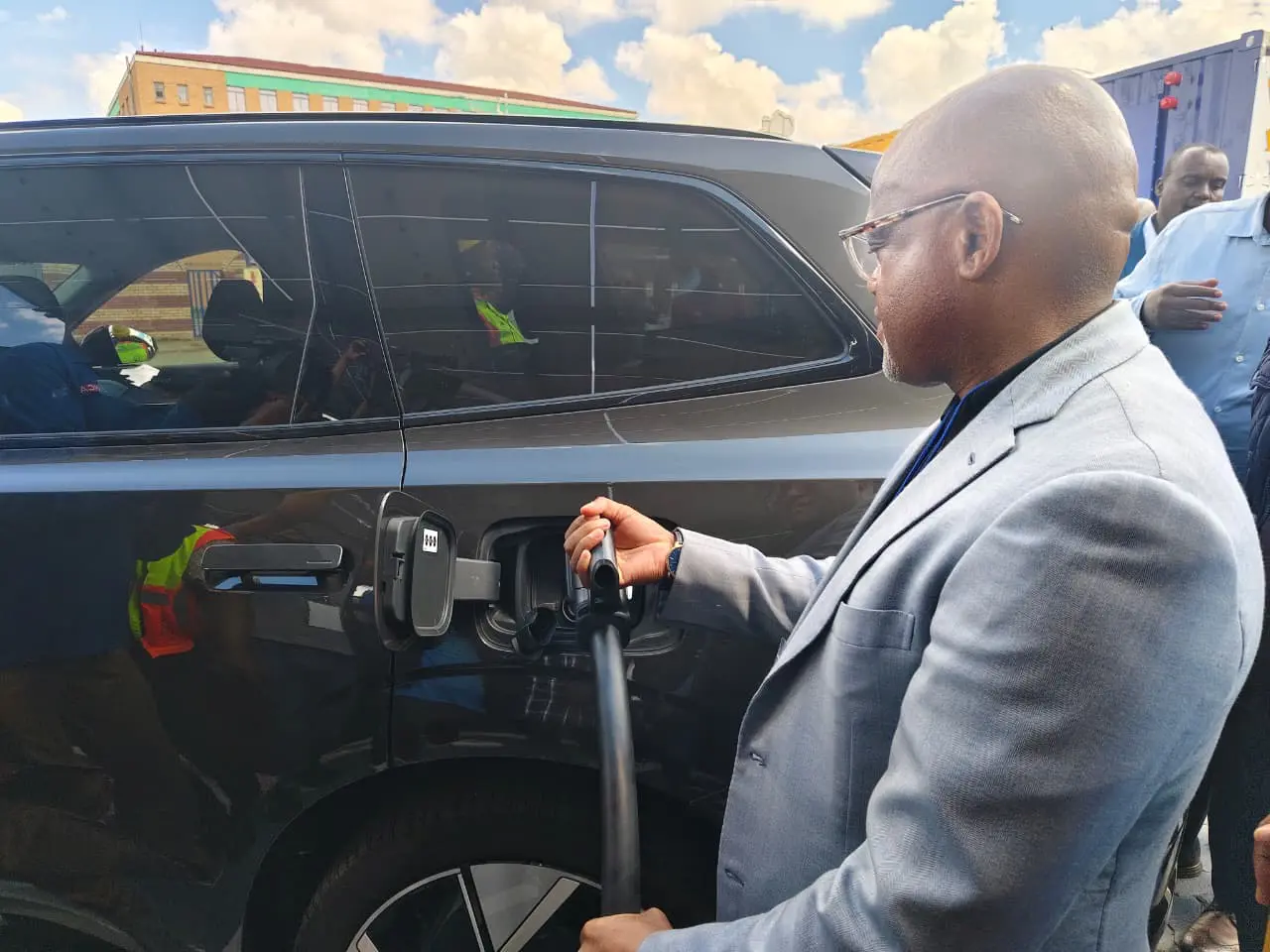
City of Johannesburg mayor, Dada Morero demonstrates how an electric vehicle charging point works, at the launch of City Power's charging station in Booysens. Picture: Supplied.
“The savings case is strongest over the full life cycle, not just in year one. Upfront costs, including vehicles, infrastructure, and training, remain a significant hurdle, particularly for municipalities already under financial strain,” he said.
While the Booysens charging station is open to the public, tariffs and payment systems are still being finalised. For now, the infrastructure primarily supports municipal operations, a deliberate choice, according to experts, as fleet-based projects are easier to control and scale.
“Public infrastructure supports residents, businesses and future commercial fleets. For City Power, the rollout is part of a bigger shift, one that ties into energy security, sustainability and long-term cost efficiency,” McLaren said.
He added that the success of that shift will depend less on ambition and more on execution.
“If Johannesburg can demonstrate that EVs work reliably within its own operations, without adding strain to an already fragile system, it could offer a model for other cities to follow,” he said.
This story is produced by Our City News, a non-profit newsroom that serves the people of Johannesburg.
Get the whole picture 💡
Take a look at the topic timeline for all related articles.
Trending News
- 33 minutes ago
FF Plus says Malema must lose his seat as MP if he fails to overturn his sentence
- 1 hour ago
Mkhwanazi admits jurisdictional breach in R14m gemstone theft case
- 2 hours ago
Standoff between EFF members and AfriForum following Malema's sentencing
- 3 hours ago
Malema granted leave to appeal his prison sentence
- 4 hours ago
Court hands Julius Malema 5 years direct imprisonment
- 6 hours ago
Madlanga Commission postpones Suliman Carrim’s testimony to 29 April
- 7 hours ago
LIVE | Julius Malema returns to court for sentencing
- 7 hours ago
Delft mass shooting: Child among 4 killed
- 8 hours ago
Malema sentencing: EFF supporters paint kuGompo streets red
- 10 hours ago
Long-running, deadly conflict between CATA & CODETA again spotlighted
- 10 hours ago
Mkhwanazi grilled for allegedly running kidnapping, extortion racket within EMPD
- 10 hours ago
More than 10k illegal firearm possession cases enrolled in 2 years – Kubayi


