Smart speed signs are reducing average speeds across Cape Town

Kabous Le Roux
16 April 2026 | 5:42Cape Town’s smart speed signs are reducing speeding on key routes, with city data showing lasting behaviour change. Officials say the tech could help cut road accidents.

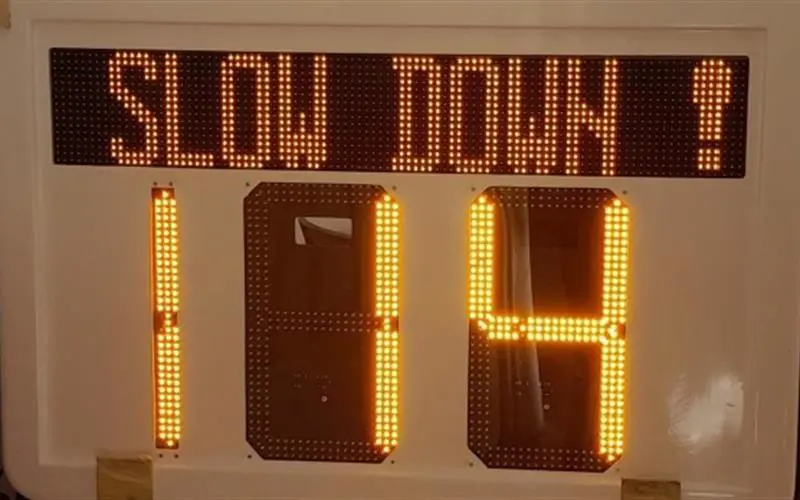
Cape Town’s smart speed sign displays a driver’s speed with a 'slow down' warning on a major route, part of the city’s rollout to reduce speeding and improve road safety. (Picture: City of Cape Town)
The City of Cape Town says its smart speed signs are proving effective at slowing drivers and could play a key role in reducing road accidents, with early data showing a sustained drop in average speeds where the technology is deployed.
Mayoral Committee Member for Mobility Rob Quintas says the signs, now installed at 10 locations across the city, are changing driver behaviour over time, not just in the moment.
Smart speed signs showing results
The digital signs display a driver’s current speed against the legal limit, prompting immediate correction.
Quintas says the approach uses behavioural ‘nudging’ to encourage safer driving.
“We are certainly seeing that where they are deployed, they are over time decreasing average speeds,” he said.
City data indicate a consistent trend: motorists spend less time speeding on roads with active signs.
Focus on high-risk routes
The smart speed signs have been installed in areas with a history of high speeds and serious crashes.
Locations include parts of the Atlantic Seaboard, Ocean View Drive, Main Road in Green Point, and sections of high-level routes.
Quintas says the technology has already shown strong results in the Atlantic Seaboard, where ward councillors first introduced the system using local budgets.
“They’ve been deployed where high speed and serious accidents have happened before,” he said.
Behaviour change beyond the moment
While drivers often slow down immediately when alerted, the key question is whether the effect lasts.
According to Quintas, early data suggest it does.
“There’s a definite, consistent trend to see better speed reduction numbers in the areas where these have been deployed for some time.”
The signs are not always active, but continuously collect data, allowing the city to measure long-term behaviour changes.
Expansion driven by ward councillors
The rollout is currently driven by ward councillors, who can fund installations through their annual allocations.
This allows communities to request signs in problem areas without waiting for citywide prioritisation.
“If there is a need… they can consider that application in their budgets,” Quintas said.
Plans: pairing with speed cameras?
The city is also considering whether smart signs could be paired with enforcement tools like speed cameras.
Quintas says current systems use separate technologies, but the idea of placing cameras further down the road is being explored.
This could help determine whether drivers maintain lower speeds or accelerate again after passing the sign.
RELATED: Reversible MyCiTi bus lane in Milnerton to reduce peak period congestion
The City of Cape Town is rolling out a tech-driven reversible bus lane system to ease congestion and improve traffic flow on the R27 corridor.
For more detailed information, listen to Quintas on CapeTalk using the audio player below:
Get the whole picture 💡
Take a look at the topic timeline for all related articles.
Trending News
- 23 minutes ago
LIVE | Julius Malema returns to court for sentencing
- 31 minutes ago
Delft mass shooting: Child among 4 killed
- 1 hour ago
Malema sentencing: EFF supporters paint kuGompo streets red
- 3 hours ago
Long-running, deadly conflict between CATA & CODETA again spotlighted
- 3 hours ago
Mkhwanazi grilled for allegedly running kidnapping, extortion racket within EMPD
- 3 hours ago
More than 10k illegal firearm possession cases enrolled in 2 years – Kubayi
- 4 hours ago
Steenhuisen claims early success in vaccination against foot-and-mouth disease
- 4 hours ago
Malema says he’ll only accept a guilty verdict from ConCourt
- 4 hours ago
Ramaphosa braves backlash for appointing Roelf Meyer as ambassador to US
- 4 hours ago
Convicted child abuser Iain Wares returns to court for extradition hearing
- 4 hours ago
Iran participating in World Cup, FIFA president confirms
- 15 hours ago
ANC removes Jeff Radebe as KZN convenor, appoints Mike Mabuyakhulu