


Purple goes viral as Women for Change SA lobbies for shutdown ahead of G20
Tasleem Gierdien
11 November 2025 | 7:34The organisation calls on women in South Africa to withdraw their power at 12pm for 15 minutes on Friday, 21 November. The movement calls on government to declare femicide a national disaster.

Women For Change South Africa, Instagram screengrab
Women For Change South Africa, a leading advocacy organisation against gender-based violence, has inspired a nationwide movement turning social media purple. The colour, symbolising strength, justice, and remembrance, honours every woman and child whose life has been taken by gender-based violence.
This wave of purple profile pictures forms part of a broader campaign calling on South African women and members of the LGBTQI+ community to shut down the nation ahead of the G20 Johannesburg Summit, scheduled for 22–23 November.
The message behind purple profile pictures is simple: one day, one message, without women, South Africa stops. Through this movement, Women For Change is urging people across the country to withdraw their power, stand in solidarity, and demand an end to gender-based violence in South Africa.
Women For Change's Merlize Jogiat, who is spearheading this movement, says the call is a demand for the government to declare gender-based violence and femicide a national disaster.
Since the announcement almost a week ago, purple has gone viral across South Africa. Iconic landmarks like the Mall of Africa in Johannesburg and other buildings have illuminated their buildings in purple to show solidarity. The movement has also spread beyond the country’s borders, as people around the world join in, a powerful reminder that gender-based violence knows no boundaries and demands a united global response.
"All we want is for them [South African government] to put resources in the right place," says Jogiat.
"South Africa is a PR state; all we care about is how we look to everybody else. When the reality of what we're dealing with as women and children in this country is so horrific. We are so desensitised to it because every day there's a GBV case in the media. What we will do is sell ourselves to the highest bidder to make money, not thinking about how this is impacting the woman next door who is beaten by her husband. We really need to think about how the citizens of this country are affected on a global scale, and it's important to highlight that a day before the G20.
"Until South Africa stops burying a woman every 2.5 hours, the G20 cannot speak of growth and progress. South Africa's femicide rate is six times higher than the global average."
Women For Change South Africa argues that the only way to end femicide in South Africa is through collective action, with everyone working together to drive real change, including men.
"We serve a group of women who are not being served by the greater system. We are aware that there are so many errors in the system that someone has to jump in and correct them. Men are not excluded from this; they are part of this conversation.
"They are the ones who can speak to the men who are the perpetrators. We want them to join the conversation and pull other men in and recognise how important it is to deal with this issue and stand behind their sisters to push them forward.
"We get things done when we stand together."
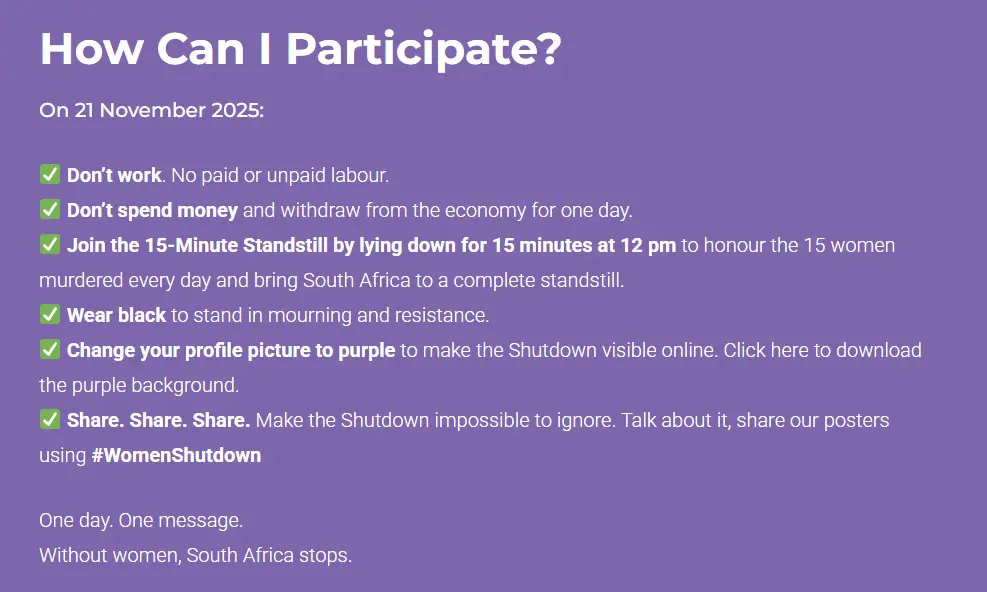
On 21 November, women and everyone in solidarity are encouraged to do one or more of the following:
- Don't work. No paid or unpaid labour.
- Don't spend money and withdraw from the economy for one day.
- Join the 15-minute standstill by lying down for 15 minutes at 12 pm to honour the 15 women murdered every day and bring
- Bring South Africa to a complete standstill.
- Wear black to stand in mourning and resistance.
- Change your profile picture to purple to make the shutdown visible online.
- Share. Share. Share. Make the shutdown impossible to ignore.
- Talk about it, share Women for Change posters using #WomenShutdown
This movement comes after the organisation’s march on 11 April 2025, when Women For Change, alongside activists and citizens, took to the Union Buildings in Pretoria carrying an unburied casket, built 33.8% larger to represent the rise in femicide, draped in mourning cloth, and adorned with 5,578 purple beads. Each bead represented a life lost, a name, a story, a woman murdered in South Africa in just one year.
During the march, the organisation also handed over a petition to the government, now carrying the voices of more than 700,000 South Africans.
Seven months later, following the viral G20 Summit Shutdown campaign and the airing of their interview, the National Disaster Management Centre issued a response.
Minister Sindisiwe Chikunga, in the Presidency for Women, Youth and Persons with Disabilities, rejected the petition’s call to declare gender-based violence and femicide (GBVF) a National Disaster, citing that 'existing frameworks' such as the National Strategic Plan on GBVF (NSP-GBVF) are sufficient.
To learn more about the G20 summit shutdown and how you can participate, click here.
To listen to Jogiat in conversation with Relebogile Mabotja on 702, click below:
Trending News
- 4 minutes ago
South Africans wake up to sharply high fuel prices
- 1 hour ago
City of Joburg fixes massive pothole after video of Zille taking a dip
- 2 hours ago
CoCT ready to support SAPS and SANDF in tackling violent crime
- 2 hours ago
SANTACO to implement any fare hikes with caution
- 2 hours ago
Bafana’s missed chances punished by Panama in Cape Town clash
- 3 hours ago
SARS Commissioner to release revenue collection tally for 2024/25
- 3 hours ago
Tshwane engages national govt on fuel shortages hitting municipal buses - Moya
- 13 hours ago
University of Fort Hare suspends Vice-Chancellor over appointment irregularities
- 14 hours ago
Sarah-Jane Trent petitions Parliament to strike incoherent testimony citing PTSD
- 15 hours ago
Tshwane Bus Services crippled by fuel shortages as city slashes shifts
- 16 hours ago
Nigerian High Commission seeks dialogue with Eastern Cape leaders following coronation unrest
- 16 hours ago
2,200 Soldiers deploy to combat crime surge across five provinces


