


MANDY WIENER: Anatomy of corruption laid bare

Mandy Wiener
28 November 2025 | 5:11We might understand better from Cat Matlala’s testimony this week how the dirty machine works, writes Mandy Wiener.
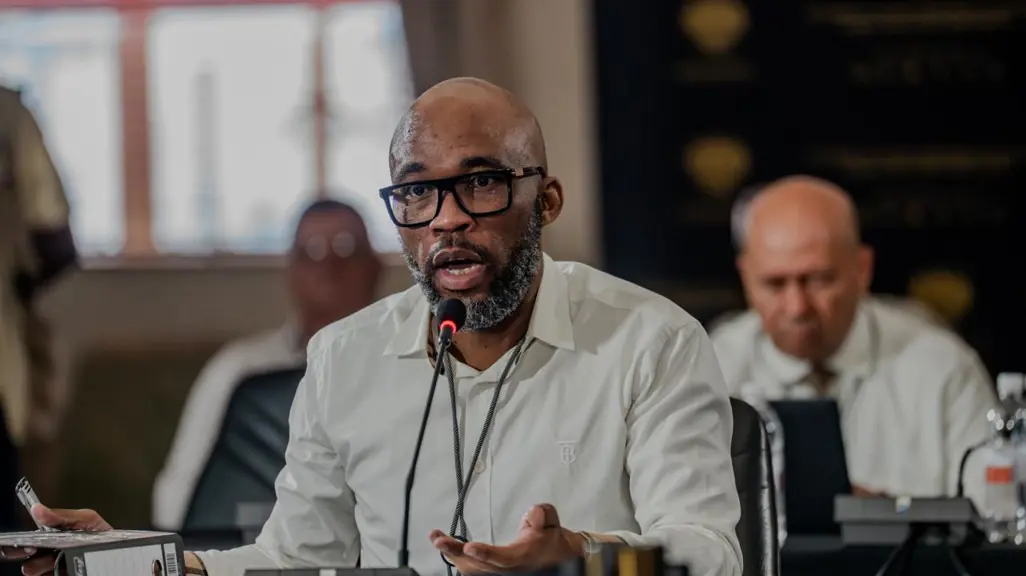
Attempted murder accused Vusimuzi Cat Matlala appears before Parliament’s ad hoc committee probing police corruption on 26 November 2025. Picture: Sphamandla Dlamini/EWN
Over my career, I’ve been criticised for interviewing gangsters, corruptors and hitmen and providing them with a platform. My argument is that there is nothing more valuable than someone complicit or responsible for wrongdoing to shed light and explain how the crime is committed.
Listening to Vusimuzi ‘Cat’ Matlala give testimony at the ad-hoc committee’s inquiry hearings this week was illuminating in much the same way.
In a remarkable set of circumstances, Members of Parliament travelled to the Kgosi Mampuru prison to hear evidence from an awaiting trial prisoner about high-level police corruption.
Matlala detailed the access he enjoyed to police generals and politicians, the influence he wielded, the cash payments he made and the benefits he received, all while denying he paid bribes or corrupting anyone.
But what Matlala described was the anatomy of corruption, laid bare for the public to fully understand.
This is how corruption works. Woolies bags, or silver packages (Bosasa) or brown leather bags (Guptas) stuffed with cash, are handed over.
here is no paper trail. There is no explicit arrangement in writing about what the money is for. But then boom – there is a tender that gets awarded, a criminal case that gets quashed or an investigation that gets called off. There are protection and influence on call.
Under questioning from DA MP and former prosecutor Glynnis Breytenbach, Matlala described giving money to ex-Police Minister Bheki Cele as ‘returning a favour’. He described Cele as being corrupt, but he was not. Breytenbach proceeded to explain how there is both a corruptor and a corrupted in such an arrangement.
She went on to suggest that ‘facilitation fees’ were a euphemism for corruption. “A bribe is a bribe. It’s to give someone money for a favour,” testified Matlala, insisting his payments were not bribes.
"You are nothing but a dishonest thug, making an illicit fortune by stealing from the poorest of the poor. Shame on you, sir," ended Breytenbach.
The former prosecutor also argued that Matlala has fashioned himself as a so-called ‘businessman’ when in fact he was a ‘crook’.
Describing dubious characters as a ‘businessman’ has indeed become a euphemism, allocating a veneer of legitimacy to those of questionable character. Using business transactions and loans as a cover has become commonplace for corruption and tender fraud.
It is deeply concerning how fraud and corruption have become so normative that they are easily passed off as legitimate.
This week, Gauteng High Court Judge Portia Phahlane was arrested on corruption charges and is accused of receiving kickbacks in exchange for fixing a case she was presiding over. It’s alleged that R2 million was paid towards the purchase of a home in Hartbeespoort.
According to the charge sheet, a week after her son purchased the property, R2 million was deposited into the trust account of the conveyancer from an account linked to one of the parties in the case.
During her bail application on Wednesday, Phahlane claimed that the charges stemmed from a personal vendetta due to her adjudication of the church saga.
Importantly, Judge Phahlane is considered innocent until proven guilty, but if indeed these allegations are proven to be true, it is yet another illustration of how comfortable corruption has become.
I have long maintained that the judiciary in South Africa is beyond reproach, and this case demonstrates a dangerous breach of the bench’s integrity and credibility. It is unprecedented.
Chief Justice Mandisa Maya noted the case with grave concern
“This incident occurs at a time when public confidence in our courts is already under strain. Recent statistics indicating a decline in the public’s perception of the Judiciary are deeply worrisome. However, it is in moments of crisis that institutions are tested and must demonstrate their resilience. The unprecedented arrest of a Judge, while deeply disquieting, also demonstrates that the country’s law enforcement apparatus and mechanisms of accountability are in motion. It signals that no individual, regardless of their position, is above the law or beyond its reach.”
CJ Maya reminds us that the rule of law is not weakened when an individual is held to account – it is strengthened.
Through the courts and ongoing inquiries, we are learning and understanding the internal workings of corruption syndicates and extraction networks in South Africa.
We are hearing about a BBL allegedly bought for a senior police officer. Cash left in dustbins. ‘Birthday money’, cash loans to top cops.
Now, even a judge stands accused.
We might understand better from Cat Matlala’s testimony this week how the dirty machine works, but that does not necessarily mean anything will come from it.
Get the whole picture 💡
Take a look at the topic timeline for all related articles.
Trending News
- 3 hours ago
Gauteng Health officials sound alarm as malaria cases and deaths double
- 5 hours ago
KZN Social Development rescues 19 children from KwaMaphumulo religious compound
- 5 hours ago
A world divided: President Ramaphosa urges progressive action against global imbalance
- 6 hours ago
Sharp temperature drop and heavy swells as cold front sweeps across South Africa
- 6 hours ago
Justice served: Woman sentenced to life for abuse of younger brother
- Yesterday
Police tight-lipped on details surrounding arrest of EMPD's Mkhwanazi
- 18/04, 11:30
Iran closes Hormuz Strait again over US blockade with ships mid-transit
- 18/04, 09:10
Julius Mkhwanazi arrested by Madlanga Commission SAPS task team
- 18/04, 06:04
Tshwane’s suspended CFO Gareth Mnisi denied helping the brother of Sergeant Fannie Nkosi
- 17/04, 15:30
Outgoing SARS chief says transactional approach to corruption isn't working
- 17/04, 12:04
Premier Thami Ntuli launches new Mayville forensic facility to speed up justice
- 17/04, 11:47
Mkhwanazi to spearhead national task team against organised crime




More in Opinion

17 April 2026 10:11
HERMAN MASHABA | Appointing Roelf Meyer as ambassador to US exposes Ramaphosa’s fixation with pandering to white nationalists

17 April 2026 08:28
JAMIL F. KHAN | When unequal death becomes law, justice gives way to political violence

16 April 2026 11:38
CHARLES MATSEKE | Celebratory shots and Malema’s legal hangover