REVIEW | Coat too tight, shoes too large: The Tramp resurfaces in a haunting musical tribute to Chaplin
Vus'umuzi Phakathi
17 February 2026 | 8:45"This is theatre worth witnessing, a work that invites audiences to sit inside history while watching it recast itself before their eyes."

“I wanted everything a contradiction: the pants baggy, the coat tight; the hat small, and the shoes large. I was undecided whether to look old or young… I added a small mustache, which, I reasoned, would add age without hiding my expression.” - Charlie Chaplin
Charlie Chaplin was born on April 16, 1889 at 8 o’clock at night, in East Lane, Walworth. A small impoverished boy from a small corner of London who would grow into a figure too large for the world to contain. A man who morphed hunger into elegance and reticence into wonder.
Daniel Anderson was born on February 11, 2000 at 13:11, in the Eastern Cape, South Africa. A small seaside child chasing horizon lines before stepping into the concrete cadence of the city, searching for a break big enough to hold his voice.
The Tramp was never born in any town at all. The Little Fellow, as Chaplin would affectionately call him, is timeless. He is ageless. A mask waiting for a body. At twenty-four, he was found by Chaplin. At twenty-five, he returned through Anderson.
But before he belongs to Anderson, before he belongs to this stage, the Tramp belongs to history.
The Little Fellow was first recognised by Chaplin in the silent cinema of the 1910s as a contrast with a cane and top-hat, a gentleman’s coat too tight for breath, trousers too large for rank, and shoes that refused the pavement yet kept sauntering. He spoke without speaking, and the world answered.
And when Chaplin finally gave voice to the encounter in his autobiography (My Biography, 1964), he recalled, “I had no idea of the character. But the moment I was dressed, the clothes and the makeup made me feel the person he was.”
The mask thus arrived first; understanding followed. By the time Chaplin waddled into frame, the Tramp revealed himself fully to the world.
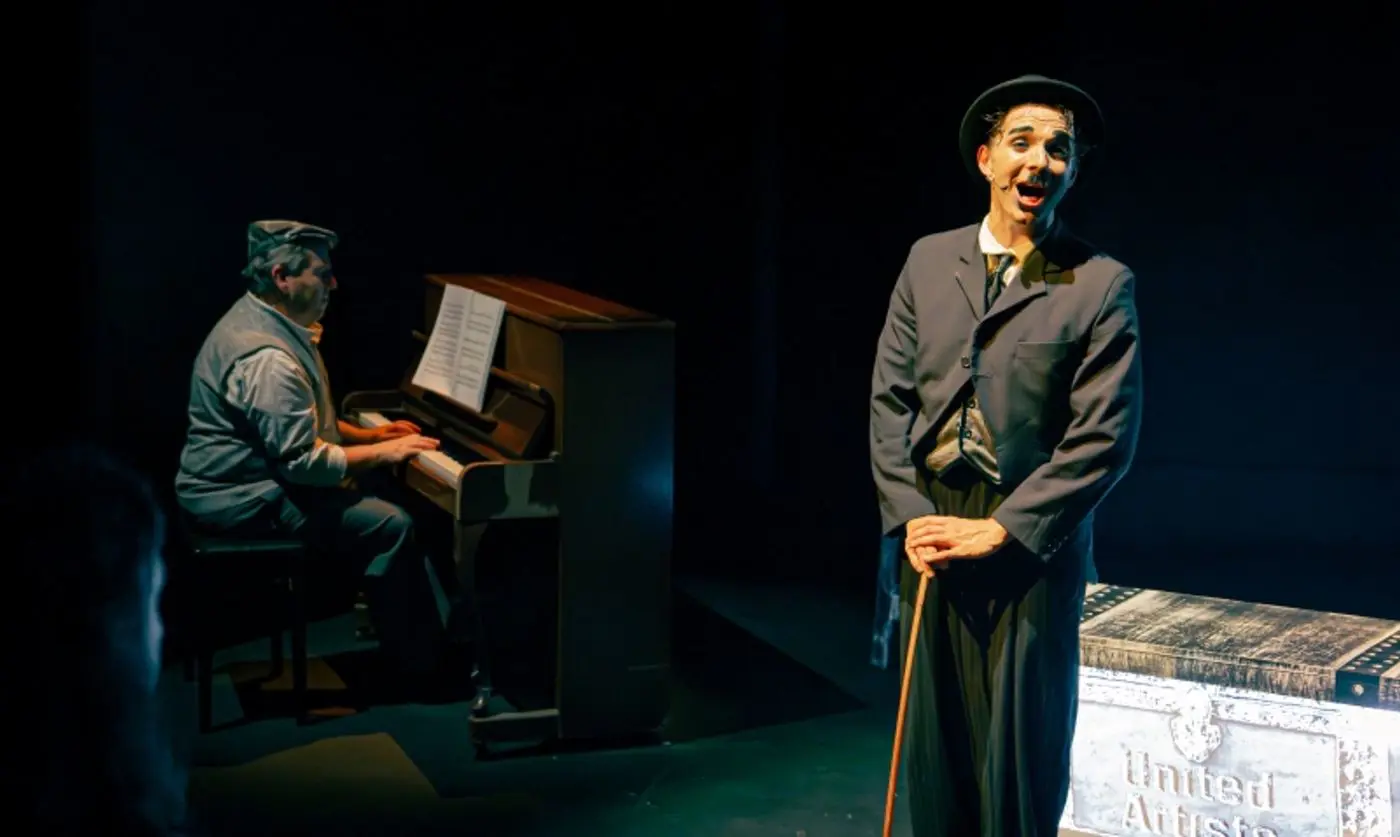
Across more than sixty films, Chaplin carried the Little Fellow from the scrappy beginnings of Kid Auto Races at Venice (1914) through to the heart-wrenching farewell of Modern Times (1936).
By the height of early film culture, newspapers and trade papers alike wrote of Chaplin as “the most recognisable face on earth,” a face the world knew most clearly when the mask was on.
It is this ghost, this global language of gesture, that now shares a personal account of its first host in a biographical musical cabaret at Theater on the Square, Sandton.
The spirit of the Tramp announces itself from the moment we enter the auditorium. A magic lantern stands in view, casting “The Tramp” across the backdrop, inviting us into the promise of silent cinema.
A piano waits at stage right, while two bare platforms and a lone wheelchair occupy the space with stubborn simplicity, and a big balloon hovers at stage left. It feels at once like a film about to begin and a performance already underway.
Once we’ve settled and lights fold, Chaplin’s “Jazz (From A Day’s Pleasure)” phantoms its way into the auditorium, and opening titles roll across the screen in the language of early cinema: “Daniel Anderson in a Tragi-Comedy Cabaret.”
The space becomes a theatre preparing to become silent cinema, a cinema preparing to become a loud confession.
Nat King Cole’s “Smile” aches from the piano, and an aged Chaplin rolls onto the stage in a wheelchair: a dim-lit figure, almost a silhouette of himself.
He is fractured, reminiscing: “I was famous once, you know. Yes. The Tramp. I was the Little Fellow, and he was me. We were one. But I haven't seen that side of myself in a while.”
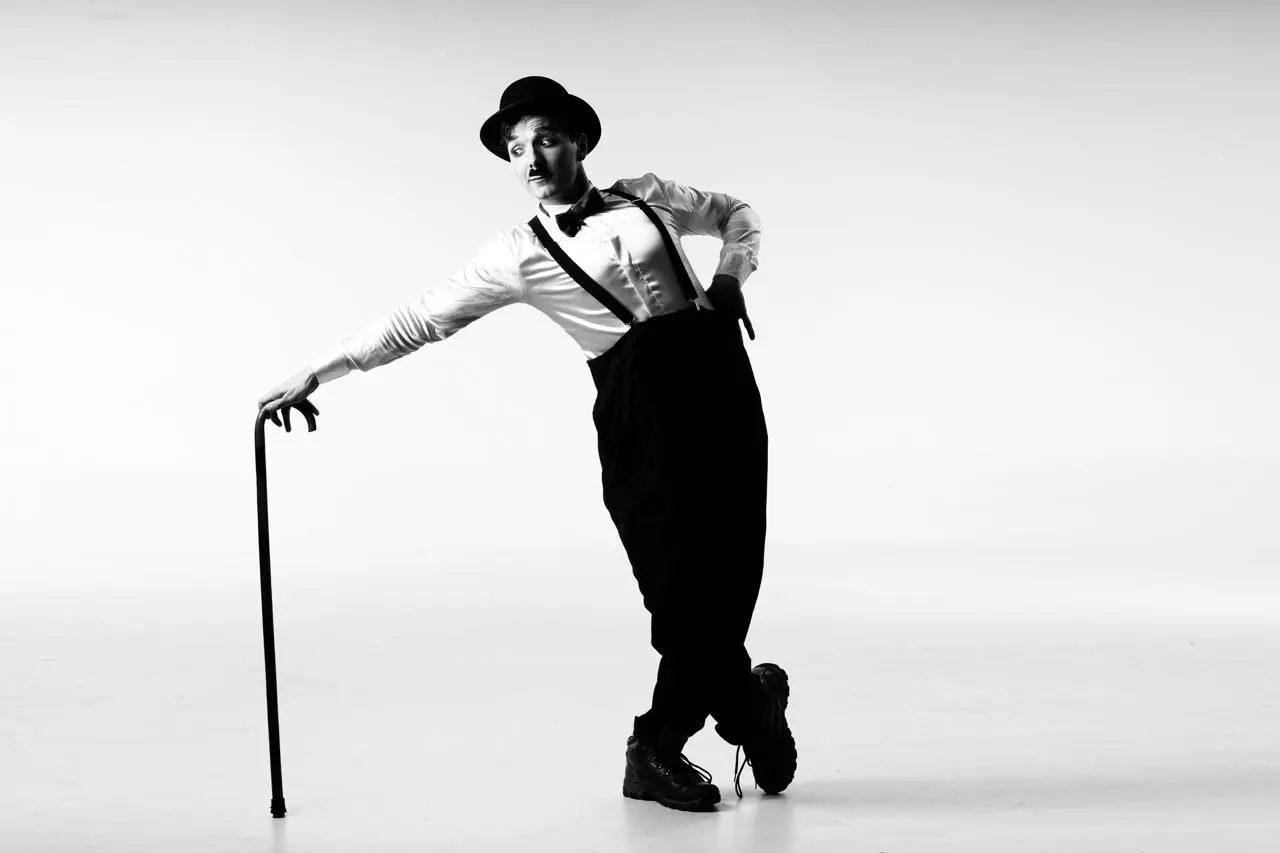
It is in this opening image, and later, in a brief re-enactment of the iconic speech from “The Great Dictator”, Chaplin’s seminal 1940 satire, that one glimpses Daniel Anderson the actor at work.
In these moments, his performance reveals a level of control and precision so exacting it borders on the surgical: every motion measured, every breath intentional, and every pause held long enough to tremble.
His presence feels simultaneously rehearsed and spontaneous, as though the choreography is discovering him at the very moment he performs it.
Beyond these fleeting glimpses, Anderson disappears almost entirely.
Across the rest of the ninety-minute cabaret, there is no visible seam between performer and persona, no trace of the young actor beneath the bowler.
There is only the Tramp: elegant in ruin, fragile in command, a vagabond… a gentleman.
The mask moves through him, until the audience forgets the body that first summoned it.
The promise of silent cinema is fulfilled, at the end of the opening scene, the moment Chaplin disappears behind the screen, calling out for a part of himself he can no longer hold alone: “It's time to come out now, little friend. Hey, Little Fellow. Little Fellow, where are you?”
A countdown flickers across the projection, and when the Tramp finally appears, first as image, then as flesh, we slips into a twenty-first-century silent film.
What unfolds next feels less like biography and more like testimony. For the first time, the Tramp tells his own version of events.
Where Chaplin’s My Biography charts the rise of an artist shaping himself against the world, this cabaret offers the counter-unveiling of a mask speaking back to its master who once abandoned it.
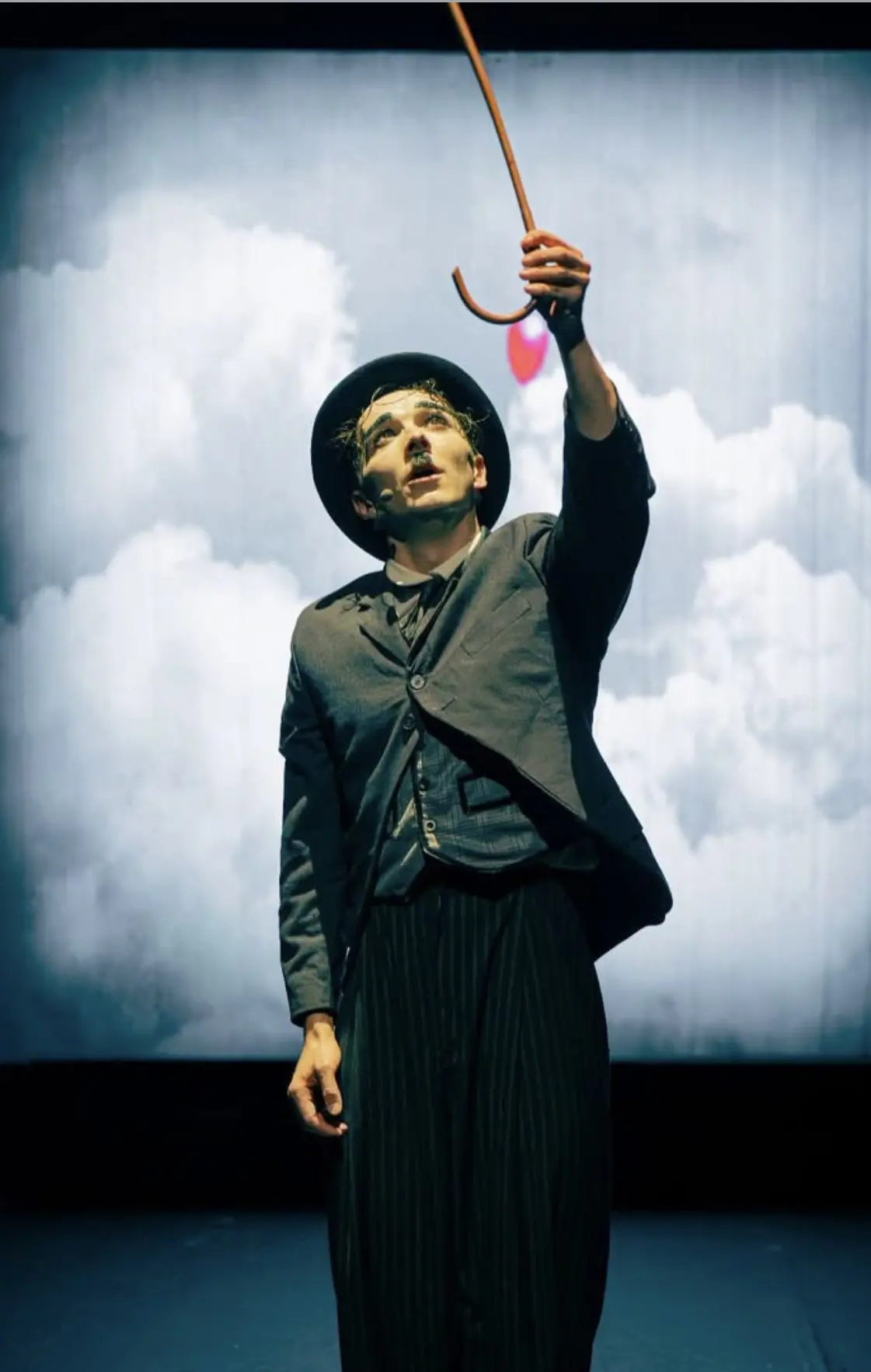
While Chaplin speaks of creating the Tramp at age twenty-four, the Little Fellow recalls meeting Charlie long before the cane, a presence at the fringes of childhood, tying the shoelaces of a six-year-old at the orphanage, and walking beside him through abandonment and ascent.
The timelines rupture gently, myth brushing against memory, until the Tramp begins to feel like a narrator shaped as much by hurt as by devotion.
He carries affection and accusation in equal measure, the two jousting gently within him, a witness who refuses to separate tenderness from grievance.
For long stretches, it becomes impossible to trace the borders between Chaplin’s Tramp and that of Anderson, and the uncertainty feels entirely natural.
The Tramp is The Tramp, belonging fully to neither past nor present, body nor reminiscence; a presence that feels older than both the man who “created” him and the performer who now carries him.
Because the Tramp speaks, the narrative reaches into spaces Chaplin’s own autobiography softened or left untouched.
The cabaret gestures toward the criticisms that have long surrounded his legacy: his controversial marriages, predilection for young women, and his politics. It does so through the eyes of an apparition who claims both loyalty and distance, refusing to let history’s rancour curdle into something rancid, instead holding the contradictions in clear light.
The tone sometimes carries a disarming lightness, inviting the audience to listen closely to what is revealed beneath the humour. In these moments, the Tramp feels less like an accuser than a witness determined to hold together the paradoxes that made Chaplin both extraordinary and flawed.
The grim gnosis within the mask remembers, and in remembering, it reframes the man who once wore it.
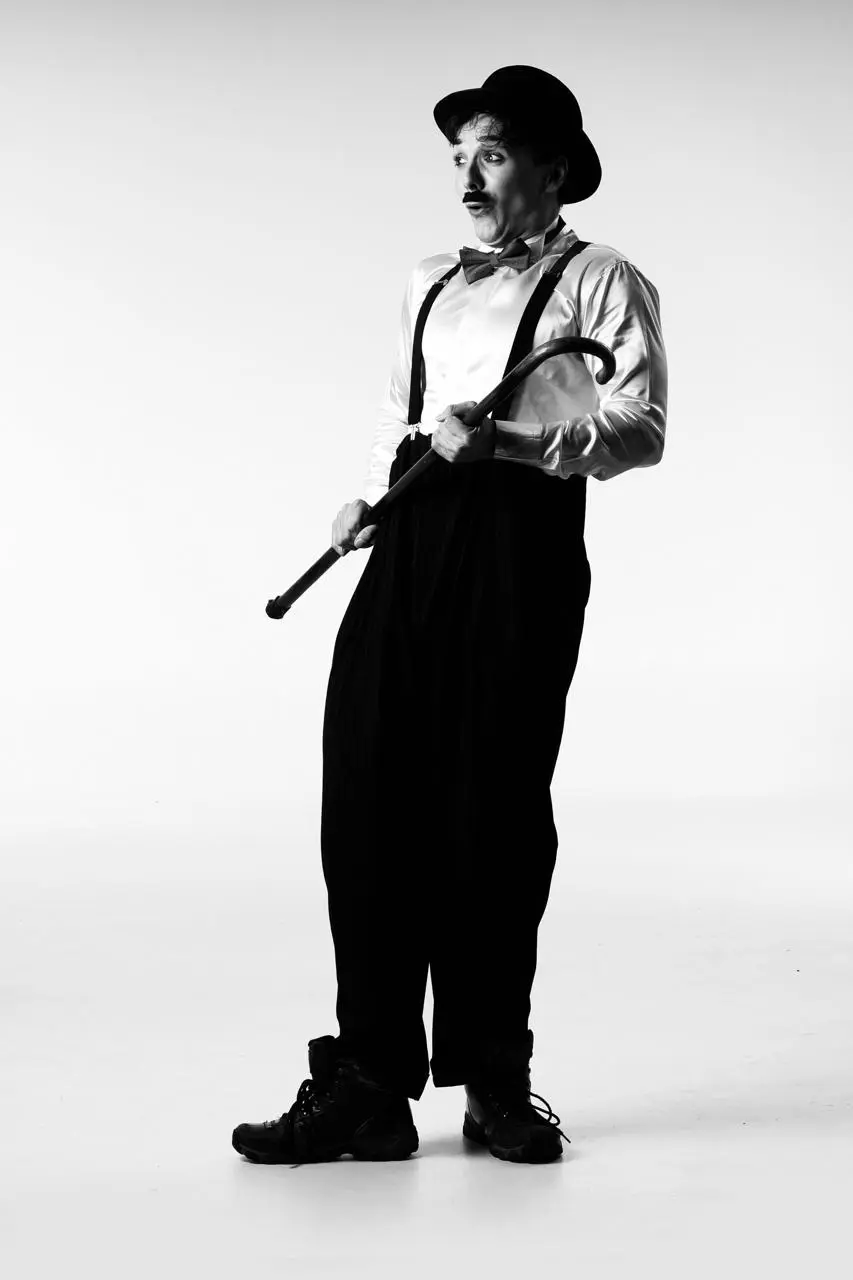
Contemporary songs drift through a world suspended in silence. They carry a perennial pulse, chosen as though the Tramp himself reached forward in time, gathering the past into the present without sealing it behind glass.
And when he sings, the room shifts. The voice a ghost discovering breath, weathered and weightless at once, fragile yet unwavering, moving between registers with an ease that feels almost supernatural.
The final number lands with the freshness of a beginning, sung as though the journey has only just begun, each note held with the quiet confidence of someone who has walked this road for decades and yet remains ageless.
Tone bends and reshapes itself from moment to moment: tender, mischievous, aching, defiant.
The music becomes anachronism and reckoning intertwined, every lyric opening another portal into the Tramp’s inner world, until the audience listens less for technique and more for the echo of a life being carried through sound.
Paul Ferreira conjures this world with stunning sensitivity on the piano, moving between accompaniment and embodiment, allowing the music to respire alongside the Tramp’s performance.
Together, they create a cabaret that feels intimate yet expansive, playful yet deeply reflective.
Light becomes an accomplice throughout the cabaret, spare in design yet attentive in effect. Shadows stretch and recede with deliberate care, allowing characters to emerge and dissolve without spectacle; a tilt of brightness frames an avowal, and a sudden dimness turns the stage inward.
ALSO READ: REVIEW | Marabi at the Market Theatre revives a music that refused to disappear
The simplicity of the lighting reveals its intelligence: every contour feels chosen, every glow positioned to guide the eye toward tension. In these shifts, light becomes another performer, summoning the rhythm of transformation as surely as accent or song.
The multimedia language of the production expands this world further. Film fragments, projected sketches, and shifting visual textures thread through the live performance, creating an occult dialogue between eras that feels fluid and unburdened by nostalgia.
What writer-director, Amanda Bothma, achieves here is remarkable: she grants the Little Fellow a voice that history once withheld. For decades audiences imagined what that voice might sound like; when cinema turned toward talkies, Chaplin chose song over speech, protecting the silence that defined the spectre.
Here, the Tramp finally speaks, and through that voice the story widens, touching on the brilliance, the fissures, and the contradictions that haunted Chaplin’s life. Every corner of the narrative feels considered, and every transition guided with prudent authority.
This is a production that lingers long after the lights fade, a reminder that the Tramp survives in the space where opposites meet: coat too tight, shoes too large, a body forever negotiating the semblance of its own shadow. This is theatre worth witnessing, a work that invites audiences to sit inside history while watching it recast itself before their eyes.
The Tramp features design by Wilhelm Disbergen (set and lighting), choreography by Sonwa Sakuba and Amanda Bothma, musical arrangements by Bryan Schimmel and Dale Ray, audio-visual design by Andrew Timm and Adino Trapani, and technical assistance from Lulutho Mhlaba.
Co-produced by Wêla Kapela Productions and Daphne Kuhn, the work is stage managed by Regina Dube, assisted by Melidah Thakadu, with technical management by Loftus Mohale, assisted by Reggie Mathebe.
The Tramp runs at the Theatre on the Square in Sandton until 28 February 2026.
Get the whole picture 💡
Take a look at the topic timeline for all related articles.
Trending News
- 16 hours ago
Health Minister visits Mankweng hospital following death of one of conjoined twins
- 17 hours ago
Transport MEC says human error to blame for three major Easter crashes in Limpopo
- 20 hours ago
One of conjoined twins separated in historic surgery in Limpopo passes away
- Yesterday
Head-on collision involving two vehicles on R37 in Ga-Chuene
- Yesterday
SIU probes R14m in COVID-19 tender fraud as asset recovery intensifies
- Yesterday
TRC recusal challenge: Zuma condemns leaked letter over Concourt move
- Yesterday
Cost of Living report shows households in SA are buckling under pressure
- Yesterday
Cabinet slams so-called coronation of Nigerian 'King'
- 02/04, 15:00
Search and seizure warrant executed at home of Sergeant Fannie Nkosi
- 02/04, 14:30
Zuma approaches Constitutional Court in urgent bid to remove Justice Khampepe
- 02/04, 12:15
Dr Ngobani Makhubu appointed new SARS Commissioner
- 02/04, 12:00
Minister Ntshavheni blames panic buying for dry pumps, rules out war impact