Sin taxes increase in line with inflation in Budget 2026
Paula Luckhoff
25 February 2026 | 17:43We interview outgoing SARS Commissioner Edward Kieswetter after the Finance Minister tables the Budget.

Smoker with cigarette and beer bottles. Pexels/cottonbro studio
Delivering his Budget Speech on Wednesday, Finance Minister Enoch Godongwana said the 2026 Budget shows that the tough fiscal choices made by government over the past few years are finally starting to pay off.
Highlights include reforms to make provinces and municipalities work better, inflation-adjusted personal income tax brackets and medical tax credits, an inflation-related increase for fuel levies, as well as the usual sin tax hikes in line with inflation this time around.
There had been predictions of an increase in alcohol taxes by up to 6.7%, but Godongwana announced that excise duties on alcoholic beverages and tobacco products would increase by 3.4%.
At the same time, the 2025/26 revenue estimate for the South African Revenue Service has been revised upward to R2 006.9 billion, from the 2025 estimate of R2 005.3 billion in the 2025 Medium Term Medium Term Budget Policy Statement (MTBPS).
Stephen Grootes interviews Edward Kieswetter, the outgoing SARS Commissioner.
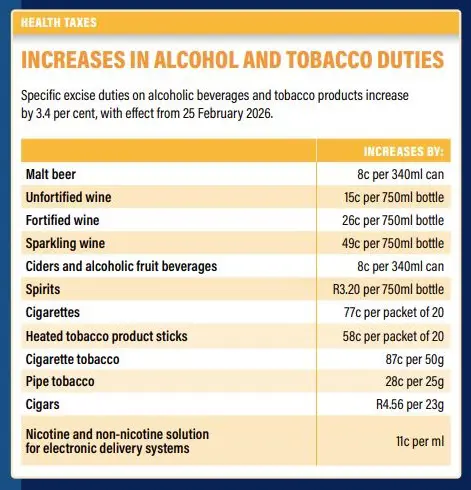
Budget 2026: Sin tax increases - National Treasury
Asked whether steep sin tax increases automatically drive the burgeoning illicit economy, Kieswetter said he does look at these as interconnected.
"In real terms, the Minister has merely adjusted these for inflation. But I have made the point - and I think he agrees with me, that we must be careful that we don't create the opportunity for arbitrage between the legal sector and the illegal sector such as we've seen during the COVID lockdown."
Revisiting what were the unintended consequences of a total lockdown of the legal trade both in alcohol and tobacco during the pandemic, he makes the following statement:
"To respond to that, whatever policy decision you make, whether it's the decision to increase the price or any other policy choice - if you do not have the capacity to enforce policy, you get an unintended consequence... and what has happened in the past is that it merely emboldened and entrenched the illicit trade into the formal economy."
RELATED:
Kieswetter also elaborates on the need for better coordination between the various agents of state to deliver a more effective response to the upsurge in both the illicit tobacco and alcohol economies.
Scroll up to the audio player to hear more from the outgoing SARS Commissioner
Get the whole picture 💡
Take a look at the topic timeline for all related articles.
Trending News
- 6 hours ago
ANC removes Jeff Radebe as KZN convenor, appoints Mike Mabuyakhulu
- 9 hours ago
Julius Malema set to learn his fate after 8 years in the dock
- 11 hours ago
IN PICS | EFF supporters gather in KuGompo City to support Malema
- 11 hours ago
From ball picker to national champion: The resilient rise of Sthabile Mnyandu
- 12 hours ago
Major General Johan Booysen withdraws as witness from Nkabinde Commission
- 12 hours ago
Ramaphosa defends appointment of Roelf Meyer as SA ambassador to US
- 13 hours ago
Tshwane CEO Gareth Mnisi placed on precautionary suspension
- 13 hours ago
State in firearms discharge case describes Malema’s actions as 'barbaric'
- 13 hours ago
Shamila Batohi defends NPA progress on TRC cases at Khampepe inquiry
- 13 hours ago
Mkhwanazi accused of being 'untruthful' about recalling alleged torture of suspect
- 15 hours ago
Malema sentencing: Lawyer argues custodial sentence would be 'grossly unfair'
- 16 hours ago
LIVE | Julius Malema returns to court for sentencing