


CHARLES MATSEKE | Trump’s performance politics and the global cost of populism
Charles Matseke
7 January 2026 | 9:09"When democracy is treated as performance domestically, international order becomes performance too."
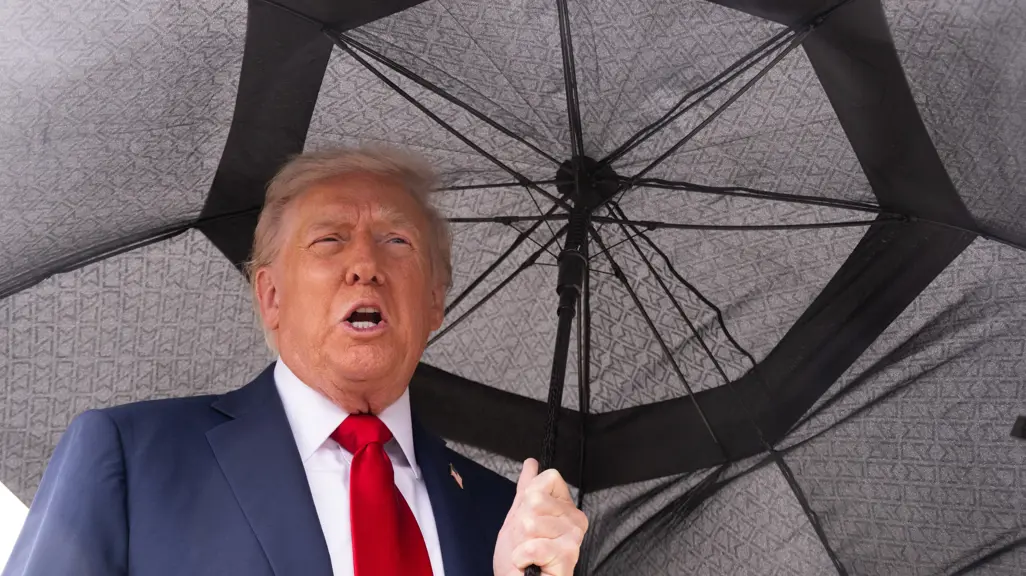
US President Donald Trump holds an umbrella as he speaks to reporters before boarding Air Force One prior to departure from Joint Base Andrews in Maryland, 12 October 2025. Picture: SAUL LOEB/AFP
Donald Trump did not invent populism, nor did he invent geopolitical instability. But across two presidential campaigns and a turbulent presidency, he has perfected a particular style of politics that treats governance as spectacle and international relations as a stage for domestic applause.
The cumulative effect has been corrosive: not only for American democracy, but for global peace, institutional trust and the fragile balance that has prevented great-power conflict from tipping into catastrophe.
From his first campaign in 2016 to his second presidential bid, Trump’s political method has remained remarkably consistent.
He identifies grievance, amplifies fear, simplifies complex realities into binary moral dramas and positions himself as the singular figure capable of restoring order.
Policy becomes secondary to performance; truth becomes subordinate to narrative utility. This approach may mobilise a political base, but it extracts a steep price from the international system.
Trump’s populismis less about redistributing power than about re-centring attention.
As Malcolm Nance argues in How to Destroy the American Dream, modern authoritarian-leaning populism does not dismantle democratic institutions overnight; instead, it hollows them out gradually by eroding norms, delegitimising expertise, and weaponising disinformation.
Trump’s repeated attacks on the media, judiciary, intelligence community, and electoral processes fit squarely within this pattern.
In foreign policy, this has translated into a worldview where diplomacy is judged not by outcomes, but by optics. Alliances are treated as transactional burdens, multilateral institutions as constraints and international law as optional.
What matters is the image of dominance, decisiveness and defiance, particularly defiance of elites, facts and established norms and principles. Performance replaces prudence.
This performance politics has had tangible consequences far beyond Washington.
Trump’s repeated claims of a “white genocide” in South Africa exemplify how domestic populist narratives are exported into international relations.
The claim, long debunked by crime statistics, academic research and South African authorities was nonetheless elevated into a diplomatic talking point. It strained bilateral relations, emboldened extremist networks and placed South Africa’s sovereignty into a fabricated moral dock.
The danger here is not merely reputational. When a US president falsely invokes genocide, one of international law’s most serious designations, the term itself is depreciated. Human rights language becomes a political prop not a legal or moral standard.
As The Plot to Destroy Democracy makes clear, the strategic spread of false narratives is not accidental; it is a method. Undermining shared reality is the precondition for undermining shared rules.
For South Africa, the cost has been diplomatic distraction and defensive posturing at a time when the global south needs stable partnerships, not manufactured crises.
This same logic is visible in Trump’s posture toward Venezuela, though the stakes there are amplified by history, resources, and power asymmetry. For more than a century, US–Venezuela relations have been shaped by oil.
Venezuela possesses the world’s largest proven oil reserves, and US engagement from Cold War interventions to sanctions regimes has repeatedly reflected energy security calculations cloaked in ideological language.
Under Trump, this long-standing tension hardened into open confrontation. The White House framed Venezuela as a “narco-state”, accused senior officials of drug trafficking and terrorism, and portrayed the Maduro government as an existential threat to regional stability.
While Nicolás Maduro’s administration has a documented record of repression, corruption, and economic mismanagement, these allegations were used to justify extraordinary pressure, sweeping sanctions, and support for regime-change strategies that bypassed multilateral consensus.
Unilateral actions taken outside international frameworks raise serious concerns about sovereignty and precedent. Human rights abuses, however grave, do not grant carte blanche for powerful states to disregard international law.
Here, Trump’s approach exposes a deeper contradiction: human rights are invoked selectively, loudly, and theatrically, yet often disregarded procedurally. The result is not accountability but cynicism. Smaller states learn that international law matters less than alignment and power politics reassert themselves under moral disguise.
These interventions and provocations unfold in a world already dangerously unstable.
The war between Russia and Ukraine continues to redraw Europe’s security architecture. The Israel–Palestine conflict remains unresolved and combustible, with persistent regional spillover risks.
Tensions between China and Taiwan, alongside disputes in the South China Sea, sit at the fault line of great-power rivalry.
On the Korean peninsula, nuclear deterrencerests on fragile assumptions of rationality and restraint.
What makes this moment uniquely perilous is not any single conflict, but convergence. As William Strauss and Neil Howe describe in The Fourth Turning, history moves in cycles, with periodic crises that test institutional resilience.
Societies entering a “fourth turning” face moments when accumulated dysfunction erupts into systemic reckoning. The early 21st century with democratic backsliding, economic inequality, climate stress, and militarised geopolitics fits this description uncomfortably well.
In such periods, leadership matters enormously. So do restraint and maturity.
Trump’s defenders often argue that global instability cannot be laid at one leader’s feet. That is true but incomplete. Leadership can function as an accelerant.
By normalising unilateralism, disparaging allies, undermining international institutions, and treating diplomacy as a zero-sum performance, Trump has contributedto an environment where escalation becomes more likely and coordination more difficult.
Crucially, his approach signals to other powers that rules are flexible and norms negotiable. If the United States treats sovereignty as conditional and truth as malleable, why should others behave differently?
In this sense, Trump’s performance politics does not merely reflect global disorder, it legitimises it.
The nuclear dimension sharpens the risk further. North Asia and South Asia host several nuclear-armed states operating in close proximity under conditions of deep mistrust. Arms-control regimes have weakened, communication channels are strained and miscalculation remains a constant danger. In such a context, theatrical brinkmanship is not just irresponsible, it is reckless.
At home, Trump’s campaigns have consistently questioned electoral legitimacy portrayed opponents as existential threats, and framed compromise as betrayal.
The Plot to Destroy Democracy documents how such rhetoric repeated often enough, primes societies to accept democratic erosion as necessary defence. Abroad, the same logic manifests as contempt for multilateralism and impatience with law. When democracy is treated as performance domestically, international order becomes performance too.
The tragedy is that none of this was inevitable The United States retains unparalleled diplomatic, economic and institutional capacity to stabilise rather than destabilise. But that capacity depends on credibility, predictability and respect for shared rules.
Trump’s populism trades these assets for applause lines. It mistakes noise for strength, disruption for strategy and dominance for leadership. The cost is borne not only by targeted states such as South Africa or Venezuela, but by a world edging closer to a multipolar, nuclear-armed disorder.
In an era that demands sobriety, Trump offers spectacle. In a moment that requires institutional repair, he delivers institutional strain. Performance politics may win elections, but it is a dangerous substitute for governance and in a fourth-turning world already flirting with systemic rupture, the margin for error is vanishingly small.
Charles Matseke (MPhil in Politics and International Relations) is a researcher and writer with a keen interest in contemporary political dynamics. His research focuses on electoral politics, foreign policy analysis, and international relations, with a particular emphasis on the Global South and Africa's role in global affairs.
Get the whole picture 💡
Take a look at the topic timeline for all related articles.
Trending News
- 15 hours ago
Police tight-lipped on details surrounding arrest of EMPD's Mkhwanazi
- 17 hours ago
Iran closes Hormuz Strait again over US blockade with ships mid-transit
- 20 hours ago
Julius Mkhwanazi arrested by Madlanga Commission SAPS task team
- Yesterday
Tshwane’s suspended CFO Gareth Mnisi denied helping the brother of Sergeant Fannie Nkosi
- 17/04, 15:30
Outgoing SARS chief says transactional approach to corruption isn't working
- 17/04, 12:04
Premier Thami Ntuli launches new Mayville forensic facility to speed up justice
- 17/04, 11:47
Mkhwanazi to spearhead national task team against organised crime
- 17/04, 10:56
Nkabinde Enquiry dismisses Batohi's bid to obtain legal advice under cross-examination
- 17/04, 10:53
Bellarmine Mugabe and co-accused plead guilty to several charges
- 17/04, 09:40
Suspended Tshwane CFO says Fannie Nkosi had ‘mistaken belief’ about helping with tenders
- 17/04, 09:08
Gauteng SASSA alarmed by unauthorised deductions from social grants
- 17/04, 08:31
NPA condemns EFF threats against prosecutor in Malema's firearms case





More in Opinion

17 April 2026 10:11
HERMAN MASHABA | Appointing Roelf Meyer as ambassador to US exposes Ramaphosa’s fixation with pandering to white nationalists

17 April 2026 08:28
JAMIL F. KHAN | When unequal death becomes law, justice gives way to political violence

16 April 2026 11:38
CHARLES MATSEKE | Celebratory shots and Malema’s legal hangover