


Jobs numbers improve, but rise in discouraged work seekers shows 'unemployment becoming structural'
Paula Luckhoff
17 February 2026 | 18:12The latest Stats SA figures show that the official unemployment rate was 31,4% in the fourth quarter of 2025. We get comment from ESG Analytics' Sifiso Skenjana.

Hundreds of unemployed young people are lining up in Katlehong, Ekurhuleni, on Thursday, 11 September 2025, to submit their CVs to the Gauteng government. Picture: Alpha Ramushwana/EWN
South Africa's official unemployment rate dropped in the fourth quarter of 2025 to 31,4%.
That's a decrease of 0,5 of a percentage point from 31,9% in the third quarter of the year.
The number of employed persons grew by 44 000 to 17,1 million, according to Statistics SA's latest Quarterly Labour Force Survey, or QLFS. (Click here for the key findings)
At the same time there was a decrease of 172 000 in the number of unemployed persons to 7,8 million compared with Q3:2025 results.
In terms of the expanded definition, the unemployment rate in the fourth quarter increases to 12.4 million - 42% of the working age population.
Stephen Grootes gets comment from economist Sifiso Skenjana, MD of ESG Analytics.
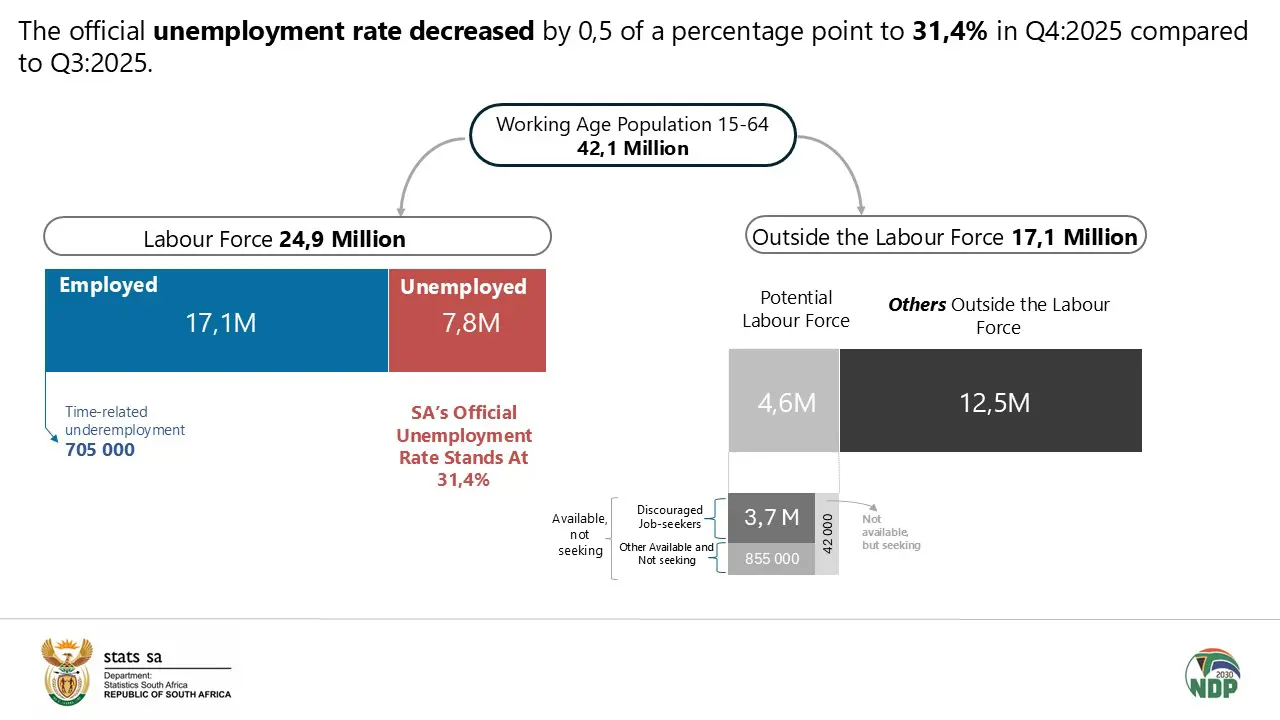
Unemployment rate Q4:2025, Stats SA
Skenjana uses the 'Beauty and the Beast' analogy to make sense of the uptick in jobs numbers, which is essentially good news for the country.
He highlights the jobs improvement in the agricultural sector as particularly encouraging - that is up 3.3% quarter-on-quarter, and 2.8% year-on-year.
"That is also on the back of a number of headwinds they had along with issues around Agoa and around the Liberation Day 30% tariffs, so to see resilience in that sector is incredibly important."
On the 'beast' side of the equation, Skenjana notes that discouraged job seekers account for 80,5% of the potential labour force.
"If I just compare from 2015 when the number of long-term unemployed people was about 66% and now it's 80% - that tells you that unemployment is becoming structural."
"The numbers are actually reinforcing that this is really not a good story to tell beyond some of the gains that we've seen in the agri-sector."
For more of Skenjana's analysis, listen to the interview audio at the top of the article
Get the whole picture 💡
Take a look at the topic timeline for all related articles.
Trending News
- 13 hours ago
Health Minister visits Mankweng hospital following death of one of conjoined twins
- 14 hours ago
Transport MEC says human error to blame for three major Easter crashes in Limpopo
- 17 hours ago
One of conjoined twins separated in historic surgery in Limpopo passes away
- 19 hours ago
Head-on collision involving two vehicles on R37 in Ga-Chuene
- 19 hours ago
SIU probes R14m in COVID-19 tender fraud as asset recovery intensifies
- 20 hours ago
TRC recusal challenge: Zuma condemns leaked letter over Concourt move
- Yesterday
Cost of Living report shows households in SA are buckling under pressure
- Yesterday
Cabinet slams so-called coronation of Nigerian 'King'
- 02/04, 15:00
Search and seizure warrant executed at home of Sergeant Fannie Nkosi
- 02/04, 14:30
Zuma approaches Constitutional Court in urgent bid to remove Justice Khampepe
- 02/04, 12:15
Dr Ngobani Makhubu appointed new SARS Commissioner
- 02/04, 12:00
Minister Ntshavheni blames panic buying for dry pumps, rules out war impact




More in The Money Show

2 April 2026 20:16
A bill awaiting the President's sign-off could be a gamechanger for SA, says analyst

2 April 2026 19:29
EV uptake in South Africa will happen faster than believed, says Volvo SA MD Grant Locke

2 April 2026 18:48
China's Chery acquires SA plant, expects first cars off assembly line in 2027