CHARLES MATSEKE | Re-examining Mkhwanazi’s July 6 statement in the Republic of Commissions
Charles Matseke
19 March 2026 | 12:00Since Lieutenant-General Nhlanhla Mkhwanazi’s July 6 briefing, the country has been pulled into a familiar cycle: inquiry, testimony, outrage and anticipation, writes Charles Matseke.
- KZN police commissioner Nhlanhla Mkhwanazi
- Madlanga Commission of Inquiry
- Investigating Directorate Against Corruption (IDAC)
- Political killings task team
- Police Crisis

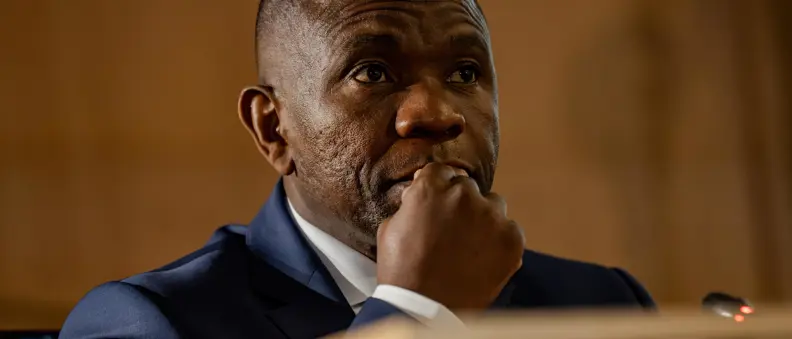
KwaZulu-Natal Police Commissioner Nahlanhla Mkhwanazi gave testimony before the Madlanga Commission at the Brigitte Mabandla Justice College in Pretoria on 17 September 2025. Picture: Sphamandla Dlamini/EWN
South Africa has heard testimony of a state under siege, of a police service infiltrated, of political interference in the security cluster, of cartels threading themselves through law enforcement. What it has not heard clearly, systematically, and under oath is a comparable account of wrongdoing within the judiciary.
That silence is not incidental. It is the architecture of the moment.
Since Lieutenant-General Nhlanhla Mkhwanazi’s July 6 briefing, the country has been pulled into a familiar cycle: inquiry, testimony, outrage and anticipation.
The parliamentary ad hoc committee has convened. The Madlanga Commission has taken evidence. Witnesses have come forward, some cautiously, others forcefully. Allegations have surfaced of political interference, criminal infiltration and systemic dysfunction.
Yet, as the evidence unfolds, a pattern emerges: the exposure is uneven.
What we are witnessing is not merely investigation shortcomings, but the manufacturing of public consent.
In Manufacturing Consent, Edward Herman and Noam Chomsky argue that power is maintained not only through coercion but through the careful shaping of public perception.
Information is filtered, narratives are structured and certain truths are amplified while others are muted. The public is not simply informed; it is guided toward a particular understanding of reality.
South Africa’s current inquiry process reflects this logic.
The focus on policing failures, cartel networks and political interference creates a compelling narrative. It produces outrage. It signals responsiveness. But it also narrows the frame. It directs attention toward specific institutions while leaving others, most notably the judiciary, largely untouched.
This is not to suggest that the judiciary is necessarily implicated. It is to point out that it has not been subjected to the same evidentiary scrutiny.
And in a system where justice is meant to be indivisible, that asymmetry matters.
The second dynamic at play is the diffusion of responsibility; what can be described as collective guilt without individual accountability.
When corruption is framed as systemic, everyone becomes implicated and no one is singularly responsible. The state appears compromised, but accountability becomes abstract. This is politically convenient. It allows institutions to acknowledge failure without confronting the individuals and networks that sustain it.
At the same time, a counter-dynamic emerges: selective exceptionalism.
Figures such as Morgan Maumela and Binjani Chauke have been exempted as central figures in a narrative of capture. Alongside them, the so-called “Big Five” cartel actors are portrayed as operating beyond the reach of the law.
This duality, collective guilt and selective villainy serve a purpose. It creates a story that is both expansive and contained. The system is flawed, but the blame is concentrated.
And once again, the judiciary remains outside the frame.
There is one allegation that continues to circulate in public discourse: that accused individuals can influence prosecutorial processes or secure favourable bail outcomes through informal networks.
The controversial bail granted to alleged crime figure Katiso Molefe has intensified these suspicions.
But suspicion is not evidence. Neither the ad hoc committee nor the Madlanga Commission has produced corroborated testimony implicating judicial actors or prosecutorial institutions.
No sustained interrogation of court processes. No detailed submissions from the NPA. No mapping of judicial decision-making under pressure.
So the question is unavoidable:
Are we dealing with institutional integrity or institutional invisibility?
South Africa has become a republic of commissions; an ecosystem of inquiry that reveals, but rarely resolves.
From previous commissions to the current Madlanga process, the pattern is clear. Allegations are surfaced. Hearings are conducted. Reports are compiled. Recommendations are issued. But systemic transformation remains elusive.
The process becomes an end in itself.
It creates the appearance of accountability and appearance of the truth without necessarily delivering truth itself.
This is not simply institutional failure. It is strategic equilibrium.
In game theory, systems with multiple actors often settle into a state of non-cooperation, where each participant reveals only partial information.
No actor fully exposes the system, because doing so would implicate themselves or destabilise the structure within which they operate.
This is precisely what we are witnessing.
The police are scrutinized. Political actors are implicated. But the judiciary remains insulated-whether by design, limitation or political sensitivity.
The result is a managed crisis: enough truth to sustain legitimacy, but not enough to trigger systemic rupture.
South Africa cannot afford another cycle of partial exposure.
Mkhwanazi’s July 6 statement opened a necessary conversation. But conversations are not conclusions.
Without corroborated evidence, cross-institutional accountability and the willingness to interrogate all arms of the state, including the judiciary, the process risks remaining trapped in the realm of verisimilitude.
Convincing. Dramatic. Politically useful.
But not yet true.
What is required is not another commission, but a national response to a systemic crisis.
First, the country needs an urgent National Dialogue, not as an ANC-led political platform, but as a genuinely inclusive process that brings together all sectors of society. The crisis of governance is no longer partisan; it is structural.
Second, the principle of separation of powers must be reaffirmed, not rhetorically, but institutionally. This requires subjecting all arms of the state, including the judiciary and prosecutorial bodies, to appropriate forms of accountability without undermining their independence.
Third, oversight and enforcement mechanisms must be strengthened. Structures such as the Political Killings Task Team (PKTT), Inter-Departmental Anti-Corruption (IDAC) frameworks, and intelligence-led operations must be empowered, insulated from political interference and properly resourced.
Fourth, there must be a serious reconsideration of legislative frameworks such as the IPID Act. Oversight bodies cannot function effectively if they are institutionally dependent on or proximally entangled with the very structures they are meant to investigate. Independence must be substantive, not procedural.
Finally, the issue of proximity to power must be confronted. South Africa’s governance crisis is not only about corruption; it is about networks, who is close to whom, who protects whom and who remains beyond scrutiny.
The danger is not that South Africa does not know what is wrong. It has become comfortable with knowing only part of it.
A system that manufactures consent, diffuses guilt, and selectively assigns blame does not collapse. It adapts.
And in adapting, it guarantees its own future.
Until the judiciary is either clearly exonerated or rigorously examined, until the full architecture of power is mapped without fear or favour, South Africa will remain suspended between appearance and truth.
Convincing. Controlled. Incomplete.
And perfectly designed to endure.
Get the whole picture 💡
Take a look at the topic timeline for all related articles.
Trending News
- 25 minutes ago
Litha Govuza murder: Family of teen shot dead in incident captured on video want justice
- 1 hour ago
Security mogul Calvin Mathibeli loses court bid as police probe firearm compliance
- 3 hours ago
Baby Nikita's murder trial set for July
- 5 hours ago
Police closing in on person of interest in fatal Driftsands shooting
- 5 hours ago
Nkosi reminded Madlanga Commission testimony can’t be used in criminal trial
- 6 hours ago
Mamelodi double murder: Accused Tebogo Mnisi back in court
- 6 hours ago
WC police, SANDF conduct drills ahead of the official Cape deployment
- 8 hours ago
Ramaphosa denies supporting Mchunu’s decision to disband PKTT immediately
- 8 hours ago
'Cat' Matlala's lawyers to challenge seizure of his electronic devices
- 9 hours ago
ANC says upcoming Human Rights Day march not an attack on government
- 9 hours ago
Mkhwanazi 'confident' there’s enough evidence to arrest Sibiya
- 9 hours ago
KZN govt calls for ‘calm & constructive engagement’ after Ingonyama Trust dissolution