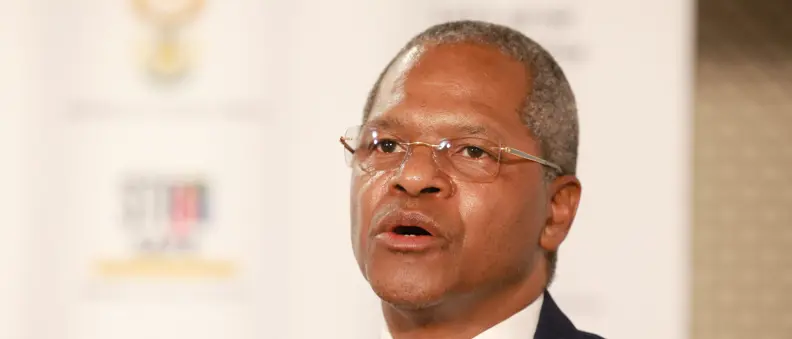
MICHAEL BEAUMONT | There is only one credible choice for Joburg mayor
Guest contributor
18 March 2026 | 13:26"If your vote is based on the self-interest of reliable service delivery for all, a Metro Police that fights lawlessness and a city that pursues corruption wherever it occurs, then there is only one choice in this election."

ActionSA leader Herman Mashaba. Picture: Katlego Jiyane/Eyewitness News
The decline of this city over the past few years has brought about a sense of despair that requires a counterbalancing force, and a heated political contest that places service delivery on the front burner can only be a good thing.
While the prevailing trend has clearly been to campaign on what is wrong with one's competitors, allow me to offer a refreshing approach by simply telling you why Herman Mashaba is the only choice for a voter who votes on service delivery and good governance.
If you vote on other grounds, I regret that I cannot assist you and suggest that there are many parties that will appeal to your race or ethnicity for your vote.
Back to the case for Herman Mashaba.
Herman Mashaba is the only candidate in this race who has a proven track record in this city, and this matters in the world of politics because voters have understandably reached the point where they trust what their leaders do more than the promises they make.
Mashaba served as Mayor of Johannesburg from 2016 to 2019, during the only period in which the city made real and tangible progress. You do not have to take my word for it. The city’s own independent resident satisfaction survey in 2019 recorded the highest levels of positive sentiment towards the city in its history at 73% and rising.
Immediately upon taking office, he began a programme of redirecting what amounted to R2 billion annually from the waste associated with international travel, conferences, self-promoting advertising and other non-essential expenditure to the delivery priorities of electricity, water, roads and housing services.
As a direct consequence of this, the average number of power outages per household per year declined, despite load shedding being prolific at the time. Water losses declined along with the number of bursts and leaks, falling from 45 000 to 37 000 per year because, while Mashaba replaced 200 km of water pipes annually, the current government replaces only 17 km per year.
Mashaba got the Johannesburg Roads Agency working, resurfacing 900 km of the city’s 4 000 km of deteriorated roads in just three years, while also repairing bridges that were in a state of imminent collapse.
The Metro Police was expanded by 1 500 new officers, increasing the force by nearly 50%, while specialised units and a ‘Boots on the Ground’ policy gave the Metro Police a visible presence across the city.
The city’s first anti-corruption unit was established. A team of former Scorpions investigators, prosecutors and forensic accountants investigated 6 000 cases of fraud, corruption and maladministration, resulting in more than 900 arrests and more dismissals of implicated officials than were recorded at the time.
The city’s approach to healthcare was revolutionary. Clinic operating hours were extended to provide life-saving healthcare and medication after hours and over weekends.
The city’s first drug rehabilitation centres were rolled out to treat the victims of substance abuse, and mobile clinics were procured to service communities in informal areas.
A first-of-its-kind inner-city rejuvenation project seized control of 158 bad buildings that had been hijacked or left vacant. These buildings were taken over by the city because their debts exceeded their value and were then handed over to the private sector for the construction of low-cost affordable housing, student accommodation and small business spaces.
Housing programmes were restructured so that the city no longer relied solely on the slow rollout of 2 000 RDP houses a year against a backlog of more than 300 000. Instead, thousands of serviced stands were provided to families to enable them to build their own homes, while these communities were upgraded into fully fledged neighbourhoods.
The budget for electrifying informal settlements increased from R30 million to R300 million. It was Mashaba who, 23 years into democracy, prioritised Kliptown, the home of the Freedom Charter, and more than 9 000 title deeds were given to families who could then own their homes as an asset.
When Mashaba became Mayor, the highest recorded level of facilitated investment into the city was R4 billion in a single year. In the year that Mashaba left office, facilitated investment reached R17 billion, with jobs being created and small business hubs established to support entrepreneurs in every region of the city.
When Mashaba discovered that the city was paying tenderpreneurs R14 000 per security guard while those security guards were receiving only R3 000 per month and being mistreated, he insourced more than 6 000 security guards and cleaners, giving them the dignity of a decent wage at the expense of the tenderpreneurs while simultaneously reducing the city’s costs for security and cleaning services.
Mashaba produced the first Memorandum of Understanding, binding in law, with trade unions, creating a partnership with the city’s more than 30 000 employees because he recognised that getting the most out of these officials represented the greatest change that could be delivered. The MoU committed the city to higher standards of care and stronger responses to cases of mistreatment in
exchange for increased stability, a partnership in service delivery and higher thresholds before a strike could be permitted.
Herman Mashaba achieved this, and much more, in a complicated minority coalition government that remained stable because he understood that true stability comes from partnership and not paternalism.
I could quite literally go on and on, but if I have not made my case to you by now, I suspect no amount of facts and evidence will do so. If your vote is based on the self-interest of reliable service delivery for all, a Metro Police that fights lawlessness and a city that pursues corruption wherever it occurs, then there is only one choice in this election. If your vote is based on other considerations, you have far more choices available. It is that simple.
Michael Beaumont is the Interim National Chairperson for ActionSA
Get the whole picture 💡
Take a look at the topic timeline for all related articles.
Trending News
- 5 hours ago
Gauteng Commissioner: Suspect in spaza owner abduction known to victim
- 7 hours ago
Fadiel Adams claims police intended to kidnap him following early morning raid
- 10 hours ago
Family of Mazwi Kubheka speaks out after missing brother escapes month-long captivity
- 10 hours ago
Missing Vosloorus spaza shop owner found alive after one month
- 02/05, 14:40
Hlabisa rallies parties for a ‘violence-free’ 2026 local government election
- 02/05, 13:00
National police take over probe into missing Vosloorus spaza shop owner
- 02/05, 10:44
Brink pledges zero-tolerance policy for Tshwane
- 02/05, 09:47
Four killed in shooting in Inanda, KZN
- 02/05, 08:27
Parts of Johannesburg still without power a week after substation fire
- 01/05, 14:35
Government considers pausing school exams for local elections
- 01/05, 13:25
DA targets corruption in Tshwane ahead of local government polls
- 01/05, 08:45
Two Home Affairs officials arrested in separate anti-corruption stings