


CHARLES MATSEKE | Celebratory shots and Malema’s legal hangover
Charles Matseke
16 April 2026 | 11:38"What began as a moment of recklessness has evolved into a constitutional test case. One that will shape not only the fate of Julius Sello Malema, but also the broader relationship between power, accountability and the rule of law in South Africa."
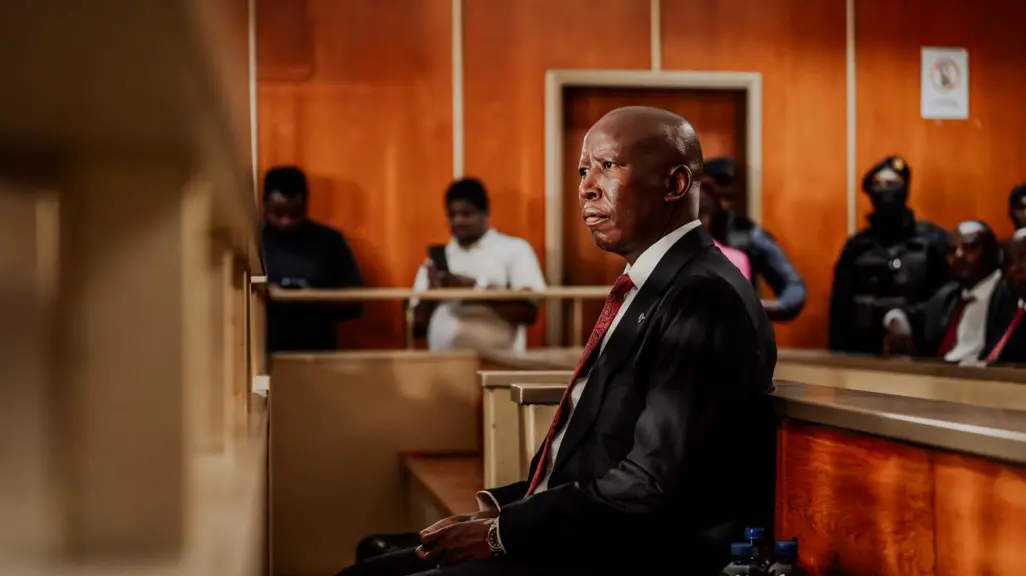
EFF leader Julius Malema in the dock at the East London Magistrate's Court for his pre-sentencing hearing. Picture: Sphamandla Dlamini/EWN
16 April 2026 may well enter South Africa’s political and legal history as more than just a sentencing date. It is a moment that forces a difficult question: where does law end and politics begin in a constitutional democracy under strain?
In the East London Magistrate’s Court, Magistrate Twanet Olivier handed down a sentence against Julius Sello Malema that has already triggered a storm of legal scrutiny and political mobilisation.
The court imposed five years’ direct imprisonment for the unlawful discharge of a firearm, two years for unlawful possession, and fines of R20,000 on each of the remaining counts. Crucially, Malema was also declared unfit to possess a firearm.
At the outset, the court made a principle clear: public office bearers must be held to a higher standard of accountability than ordinary citizens. Few would dispute that proposition. But it is precisely in the application of that principle that the controversy now lies.
From a legal standpoint, the judgment raises serious questions about consistency with precedent, proportionality in sentencing and the proper application of inferential reasoning.
South African criminal law has long emphasised caution when dealing with circumstantial evidence. The seminal case of R v Blom (1939) established two cardinal rules: the inference drawn must be consistent with all proven facts, and it must exclude every reasonable alternative explanation.
The defence, during oral argument, contended that these principles were not adequately satisfied. They raised concerns of material misdirection, arguing that the court may have improperly weighed evidence and reached conclusions not fully supported by the factual record.
More pointedly, they accused the court of engaging in false equivocation; a logical and legal error where materially different facts are treated as equivalent.
This is not a trivial claim. South African jurisprudence, including cases such as Meintjies v S (2025), has warned against collapsing distinctions between minor inconsistencies and substantive contradictions.
A witness’s imperfect recollection cannot be equated with deliberate fabrication. If such distinctions were blurred in this case, then the evidentiary foundation of the conviction itself becomes contestable.
But the real flashpoint is the sentence.
Comparative case law suggests that incidents involving celebratory discharge of firearms, while unquestionably unlawful and dangerous’ have seldom resulted in direct imprisonment of this magnitude.
In many instances, courts have imposed fines or suspended sentences, particularly where no injury resulted. If Malema’s sentence represents a significant departure from this pattern, the legal question becomes unavoidable: what justifies the deviation?
The answer, some argue, lies in deterrence and the symbolic weight of leadership. A political figure who discharges a firearm in public may warrant a harsher sanction precisely because of their influence. Yet even this argument must operate within the bounds of proportionality and consistency, cornerstones of South African sentencing jurisprudence.
Outside the courtroom, the case has taken on a life of its own.
The involvement of organisations such as AfriForum and political actors like the Freedom Front Plus has reinforced the perception ‘fair or not’ that this is not merely a legal dispute, but a politically charged confrontation.
For supporters of the Economic Freedom Fighters, the narrative has already crystallised: Malema is being singled out for harsh treatment because he represents an existential challenge to entrenched economic and racial power structures.
This perception is not without consequence. Secretary-General Marshall Dlamini has pointed to the operational strain imposed by prolonged legal battles, noting that repeated court appearances divert leadership from grassroots mobilisation.
At the same time, the party has strategically reframed the case as evidence of political persecution, using court dates as rallying points to consolidate support.
The legal stakes are equally significant.
Under South Africa’s constitutional framework, any individual sentenced to more than 12 months’ imprisonment without the option of a fine is disqualified from serving as a Member of Parliament, once all appeals are exhausted.
This places Malema’s political future and by extension, the leadership trajectory of the EFF’ squarely in the hands of the appellate courts.
What unfolds next will test more than just the merits of the case. It will test the credibility of the judiciary itself.
If the appeal succeeds, it may affirm the corrective capacity of the legal system, reinforcing the principle that justice must not only be done, but be seen to be done.
Yet it will also raise uncomfortable questions about the reasoning that led to such a severe sentence in the first place. If the appeal fails, the judgment risks becoming a rallying symbol for claims of selective justice and institutional bias, further polarising an already divided political landscape.
At its core, this case sits at the intersection of three powerful forces: law, politics, and perception. The judiciary must assert its independence and uphold legal standards without fear or favour. But it must also remain acutely aware that its legitimacy rests on public confidence in its fairness and consistency.
The danger is not simply that justice may be misapplied. It is that justice, when perceived as uneven or politically entangled, loses its authority altogether.
The celebratory shots fired years ago may have lasted only seconds. But their legal and political aftershocks are proving far more enduring. What began as a moment of recklessness has evolved into a constitutional test case. One that will shape not only the fate of Julius Sello Malema, but also the broader relationship between power, accountability and the rule of law in South Africa.
For now, the country waits. The appeal will determine the legal outcome. But the political consequences are already unfolding and they may prove far more lasting than the sentence itself.
Charles Matseke (MPhil in Politics and International Relations) is a researcher and writer with a keen interest in contemporary political dynamics. His research focuses on electoral politics, foreign policy analysis, and international relations, with a particular emphasis on the Global South and Africa's role in global affairs.
Get the whole picture 💡
Take a look at the topic timeline for all related articles.
Trending News
- 20 minutes ago
Mkhwanazi admits jurisdictional breach in R14m gemstone theft case
- 2 hours ago
Standoff between EFF members and AfriForum following Malema's sentencing
- 3 hours ago
Malema granted leave to appeal his prison sentence
- 3 hours ago
Court hands Julius Malema 5 years direct imprisonment
- 6 hours ago
Madlanga Commission postpones Suliman Carrim’s testimony to 29 April
- 6 hours ago
LIVE | Julius Malema returns to court for sentencing
- 7 hours ago
Delft mass shooting: Child among 4 killed
- 7 hours ago
Malema sentencing: EFF supporters paint kuGompo streets red
- 9 hours ago
Long-running, deadly conflict between CATA & CODETA again spotlighted
- 9 hours ago
Mkhwanazi grilled for allegedly running kidnapping, extortion racket within EMPD
- 9 hours ago
More than 10k illegal firearm possession cases enrolled in 2 years – Kubayi
- 10 hours ago
Steenhuisen claims early success in vaccination against foot-and-mouth disease


More in Opinion

15 April 2026 10:28
MALAIKA MAHLATSI: In Netanyahu, the Western world created a very dangerous monster

15 April 2026 06:52
Melanie Verwoerd: Roelf Meyer the right choice for high-stakes Washington role

13 April 2026 10:54
CHARLES MATSEKE | Middle East war: Is Trump engineering a new deal through conflict?