CHARLES MATSEKE | Trump, Davos and Greenland: From the Monroe Doctrine to the Donroe Doctrine
Charles Matseke
21 January 2026 | 7:52"The central question is whether global politics will be governed by institutions or impulses, rules or deals, order or spectacle."
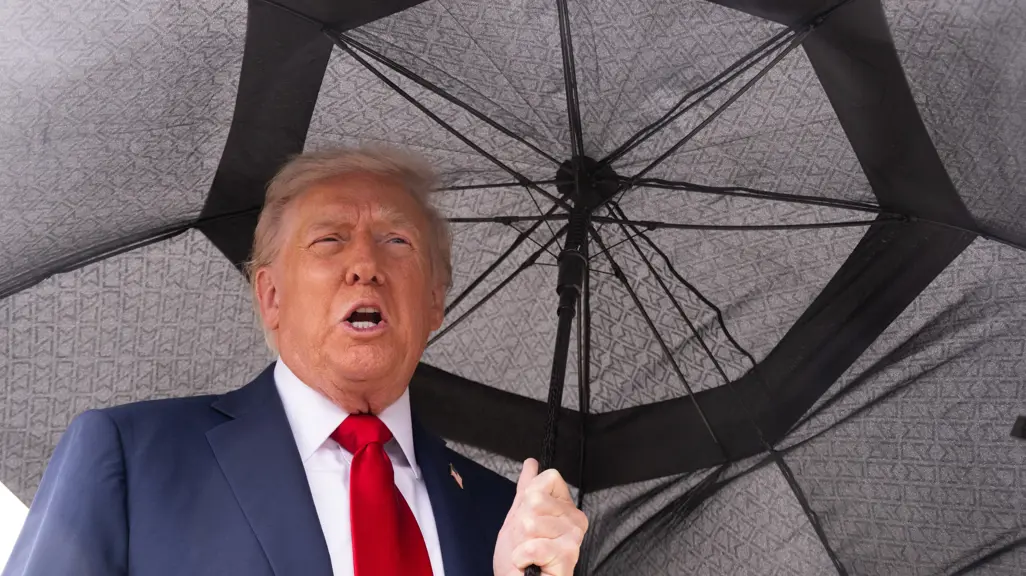
US President Donald Trump holds an umbrella as he speaks to reporters before boarding Air Force One prior to departure from Joint Base Andrews in Maryland, 12 October 2025. Picture: SAUL LOEB/AFP
For more than two centuries, the Monroe Doctrine shaped how the United States understood its place in the world.
Articulated in 1823 as a warning against European colonial encroachment in the Western Hemisphere, it later mutated into a justification for American interventionism, regime change, and hemispheric dominance.
What we are witnessing today, under Donald Trump’s second presidency, is not a departure from that tradition, but its most unrestrained evolution.
What I describe as the Donroe Doctrine has now entered a new and dangerous phase.
On the 1st anniversary of Trump’s return to the White House and on the eve of his appearance at the World Economic Forum in Davos, the United States is embroiled in an unprecedented confrontation with its own allies over Greenland; a self-governing territory of Denmark and a NATO member state.
Trump’s renewed insistence that the U.S. must “control” Greenland, backed by threats of punitive tariffs against European economies, marks a qualitative shift in Western statecraft.
This is no longer merely performance politics. It is the return of acquisition logic to global affairs.
In my earlier op-ed, Trump’s Performance Politics and the Global Cost of Populism (Eyewitness News, January 2026), I argued that Trump’s foreign policy was not doctrinal in any classical sense.
It was performative’ driven by spectacle, impulse and leverage rather than strategy, diplomacy or institutional restraint. Greenland confirms that diagnosis and pushes it further.
For the first time in the post-1945 era, a leading liberal democracy has openly treated the sovereign territory of an ally as a negotiable asset, subject to economic coercion.
Trump’s threats of tariffs unless Denmark effectively relinquishes Greenland are not negotiating tactics. They are economic blackmail.
What collapses here is a foundational pillar of the post-war international order: the distinction between adversaries and allies. Under the Donroe Doctrine, that distinction disappears. There are no partners, only leverage points.
Trump’s defenders call this realism. It is not. Realism recognises power competition, but it also understands that durable power depends on predictability and restraint.
What Trump practises is something else entirely: transactional power, shaped less by statecraft than by real-estate logic. Territory becomes property. Alliances become contracts. Institutions become obstacles. Sovereignty becomes conditional.
Greenland is not simply an ice-covered island suddenly thrust into geopolitical imagination. It is a strategic linchpin in a rapidly transforming Arctic order.
It anchors missile-defence and early-warning systems between North America and Europe. It holds vast reserves of critical minerals and hydrocarbons.
As climate change opens new Arctic shipping routes, Greenland’s strategic value will only intensify.
From a power-politics perspective, U.S. interest is understandable. What is unprecedented is the method: threatening allied economies to force territorial concession.
The backlash has been swift and revealing. Denmark and Greenland have categorically rejected any notion of sale or annexation, reaffirming their sovereignty and NATO commitments.
European leaders have warned that Trump’s tactics resemble those of authoritarian powers rather than democratic allies. Protests under the banner “Hands Off Greenland” have erupted across Greenland and major European cities.
Even Russia has entered the discourse, remarking that Trump would “go down in history” if he succeeded; a striking intervention from a state well acquainted with territorial ambition.
Trump’s appearance at Davos today comes against this backdrop: one year into his second term, amid rising alliance anxiety, tariff diplomacy, and open challenges to post-war norms. Davos was once the cathedral of liberal globalization, a space where markets, multilateralism and Western leadership converged.
Trump’s presence there now symbolises something unorthodox.
He is not arriving as a steward of global order, but as its most powerful disrupter. Institutions are treated as optional. Norms as inconveniences. Unpredictability is no longer a risk to be managed, it is elevated into strategy.
This is the deeper significance of Greenland. Trump did not invent the crisis of global governance, but he has stripped away its remaining restraints.
It is precisely in this vacuum that China’s Global Governance Initiative (GGI), alongside the Global Development Initiative (GDI) and Global Security Initiative (GSI) has gained traction’ not because China is altruistic or benign, but because Western leadership has become erratic, transactional and inward-looking.
The GGI advances a deceptively simple proposition: global order requires institutions, predictability and coordination, not impulse and coercion.
The GDI recentres development as the foundation of stability, particularly for the Global South. The GSI rejects bloc politics in favour of dialogue and what Beijing terms “indivisible security”.
Taken together, these initiatives form a governance triad. They signal China’s ambition to position itself not merely as an economic or technological power, but as a provider of order in a system increasingly defined by Western volatility.
This does not make China benevolent.
The South China Sea reminds us of that. Like Greenland, it is a strategic frontier: resource-rich, geopolitically vital and fiercely contested. Yet the contrast is instructive. In the South China Sea, China frames its actions however controversial as sovereignty consolidation, wrapped in governance language and regional dialogue.
In Greenland, the United States is openly threatening allied economies to force territorial acquisition.
The difference is not moral. It is structural.
The post-Trump world order will not revert to liberal hegemony. That era is over. What replaces it will be plural, unstable and contested. The central question is whether global politics will be governed by institutions or impulses, rules or deals, order or spectacle.
Greenland offers a stark warning. When power is stripped of restraint, even allies are no longer safe. In such a world, governance initiatives however imperfect, however self-interested, become attractive not because they are virtuous, but because they promise stability.
The tragedy is that it took the Donroe Doctrine, unveiled in full view at Davos, to make this reality unmistakably clear.
Charles Matseke (MPhil in Politics and International Relations) is a researcher and writer with a keen interest in contemporary political dynamics. His research focuses on electoral politics, foreign policy analysis, and international relations, with a particular emphasis on the Global South and Africa's role in global affairs.
Get the whole picture 💡
Take a look at the topic timeline for all related articles.
Trending News
- 1 hour ago
National police take over probe into missing Vosloorus spaza shop owner
- 3 hours ago
Brink pledges zero-tolerance policy for Tshwane
- 4 hours ago
Four killed in shooting in Inanda, KZN
- 6 hours ago
Parts of Johannesburg still without power a week after substation fire
- Yesterday
Government considers pausing school exams for local elections
- 01/05, 13:25
DA targets corruption in Tshwane ahead of local government polls
- 01/05, 08:45
Two Home Affairs officials arrested in separate anti-corruption stings
- 01/05, 08:30
KZN police hunt suspects after killing of Crime Intelligence officer
- 01/05, 06:06
Ramaphosa concerned about significant volume of water lost before it reaches households
- 30/04, 16:03
Parliament reviews system overhaul as 2026 election date is set
- 30/04, 13:42
Tolashe blames former spokesperson for 'misinformation campaign' amid mounting scandals
- 30/04, 11:49
Ramaphosa sets 4 November as local government election date