


REVIEW | Marabi at the Market Theatre revives a music that refused to disappear
Vus'umuzi Phakathi
9 February 2026 | 13:41To name a work Marabi is to invite the sweat, the sway, the repetition, the dismay, the danger of pleasure taken under watchful eyes onto the stage. It asks the work to understand music as life to be consumed and embodied.

“Music is a site of memory and forgetting, hope and despair, freedom and repression: that is its burden.” - Christopher Ballantine (Marabi Nights: Early South African Jazz and Vaudeville,)
Marabi is a music that fermented in shacks held together by tin, timber, and repetition; in structures never meant to last, yet standing night after night because bodies kept surreptitiously finding their way back.
It lived where people gathered to drink, to dance, to lean into one another when the city refused camaraderie. Shebeens and yards became temporary homelands, nailed together by piano loops, clapping hands, and bodies moving in concord.
The dance floor held contradictions without apology: pleasure beside exhaustion, laughter beside grief, desire beside discipline. No one asked the music to resolve anything. It only needed to muddle time.
To name a work Marabi is to invite the sweat, the sway, the repetition, the dismay, the danger of pleasure taken under watchful eyes onto the stage.
It asks the work to understand music as life to be consumed and embodied.
When a play becomes heritage and is poured again for a new generation, the question shifts to what still intoxicates. What still moves the body? What still invites the dance? And what has been kept out of respect in place of necessity? A revival refreshes the brew, but it also reveals whether the rhythm still flows from floor to spine.
It is within this charged space that Marabi, revived at The Market Theatre, must now be encountered.
We entered Marabi as invited guests to a gathering: a piano already playing, the instrument fully visible, the pianist seated and steady, as if the night had begun without us. The sound met us mid-step and asked us to adjust our bodies to it. It was beautiful, assured, it was composed.
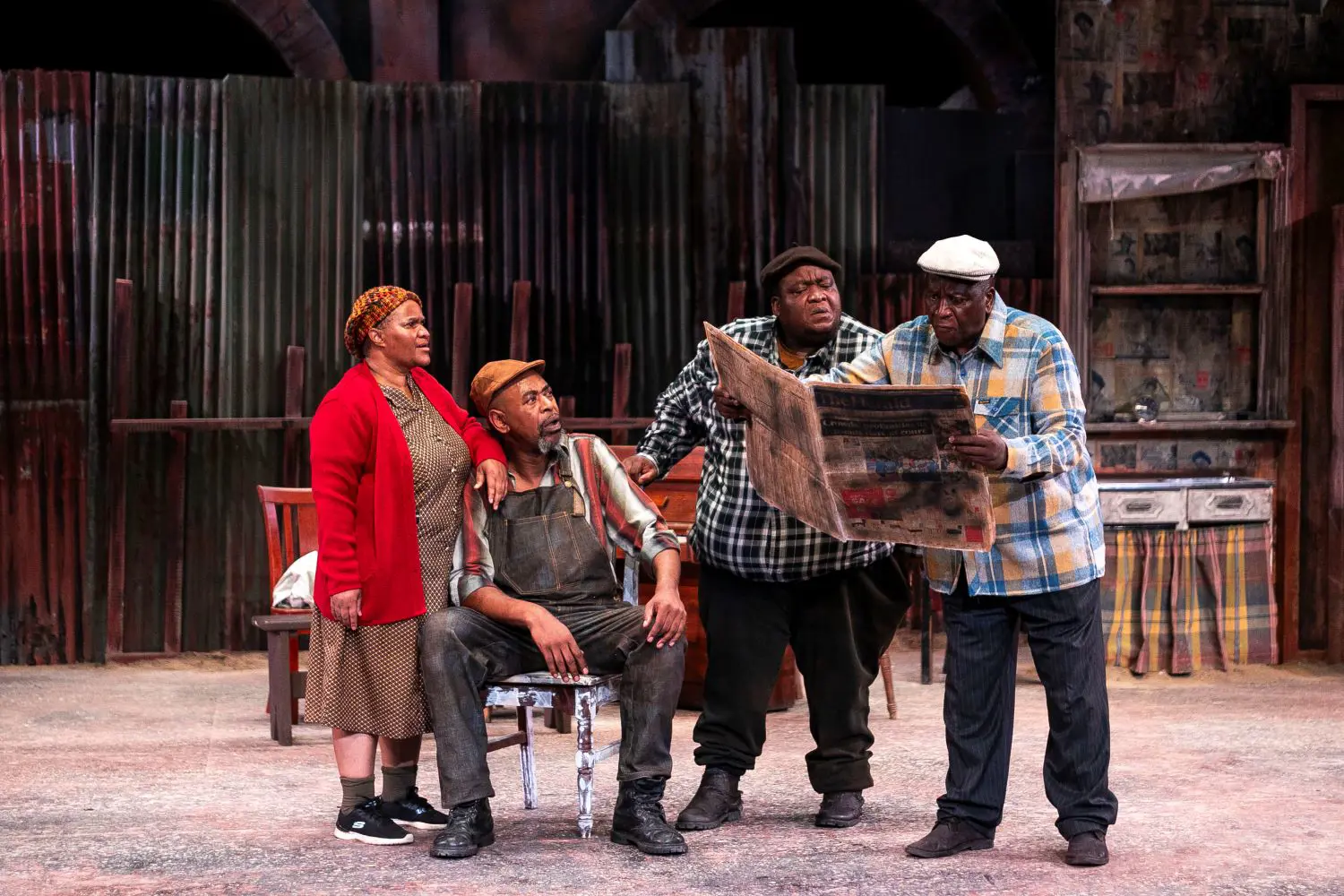
Yet the music drew us into a different room than the one the title promised. It carried the calm of classical jazz over the looping insistence of marabi, lulling the body instead of loosening it. From the outset, the production introduced a tonal shift that matters: the atmosphere being prepared was refined, even reverent, and it immediately raised the question of what kind of intoxication the evening intended to offer.
The set extended this uncertainty. Corrugated iron stretches across the stage, textured and imposing, suggesting a yard, a communal dwelling, a holding space for shared life. An upper platform cuts across the top of the design, establishing a vertical relationship: above and below, overseer and participant, interior and exterior. These are powerful spatial tools when used deliberately.
Alas, the upper level was however activated only once throughout the entire production.
After we had settled, the patriarch, Mabongo (played by Sello Sebotsane), made a powerful entrance singing from this elevated position.
The cast as chorus gathered on the floor with their voices rising to meet his. For a moment, this vertical staging promised something: hierarchy, separation, surveillance, ancestral distance, and aspiration. Then the space was abandoned. The upper level was never returned to, never reassigned, never re-signified, never asked to hold further meaning.
This is a choice that demands interrogation, is it not? Levels are meant to organise power, visibility, and relationship, thus to use height once is to gesture toward symbolism without committing to its consequences.
We were met with another unresolved intrusion with the entrance of a pair of policemen during an enthralling number by the chorus. They arrived with force, cutting across the rhythm of the opening sequence.
The chorus recoiled and the children’s fear was immediate and legible. In this moment, repression entered the body of the play. The shack tightened. The music shifted. The danger of pleasure halted under watchful eyes become briefly, unmistakably real.
And then the police exited.
They did not return. Their presence was not developed, or allowed to haunt the later action. Like the upper level of the set, they appear once, make their mark, and they disappear.
Taken together, these choices began to form a pattern. Elements with the potential allotted to govern rhythm were introduced, tasted, and then abandoned.
The brew was started, but not allowed to ferment. The floor was cleared, but the dance did not descend.
What Marabi offers in its opening movements is abundance: sound, image, texture, and threat. What it withholds is insistence. The repetition that gives marabi its power is interrupted by decisions that feel provisional and not committed.
The question that now surfaces is whether the play knows which elements must keep returning in order for the dance to mean something.
With the progression of the production the inconsistencies persisted. Costume, too, struggled to track time. Characters changed looks midstream while others remained fixed, with no clear relationship to time or transformation.
Instead of marking the rhythm of the night, these changes blurred it.
A slight laxity in costume is forgivable, but when one is invited to a gathering with the expectation of indulging in gallons of Mma Mabongo’s skokiaan, only to be offered quick gulps of lowly slug, that becomes difficult to ignore.
Buckets full of the story of marabi is what was promised. We were promised the “power of music as a transcendent force, using rhythm to guide us back to our roots.” according to director, Arther Molepo. We were promised a musical. What we received was a drama that hosted music, instead of one brewed through it.
The story began as one brew, announced early in a train with confidence, suggesting we were about to watch marabi come into being. We took it in, followed it into the yard, waited for it to thicken. Before it did, it was replaced.
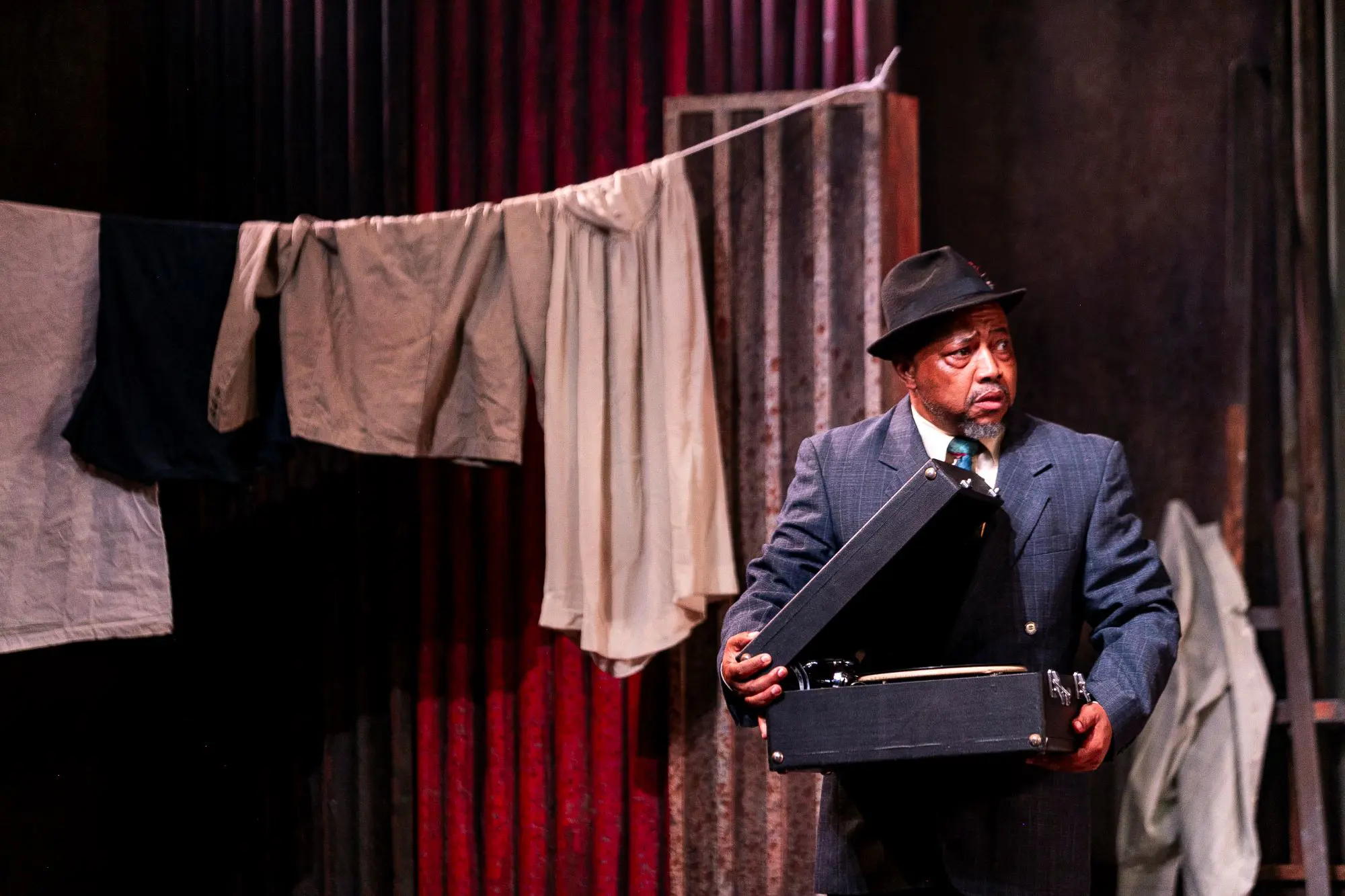
Later, a gramophone arrived, altering the flavour entirely, introducing a sharp and compelling tension between live sound and recorded sound, presence and preservation. For a moment, the rhythm tautened, and the dance adjusted. Then the needle lifted, and the brew changed again.
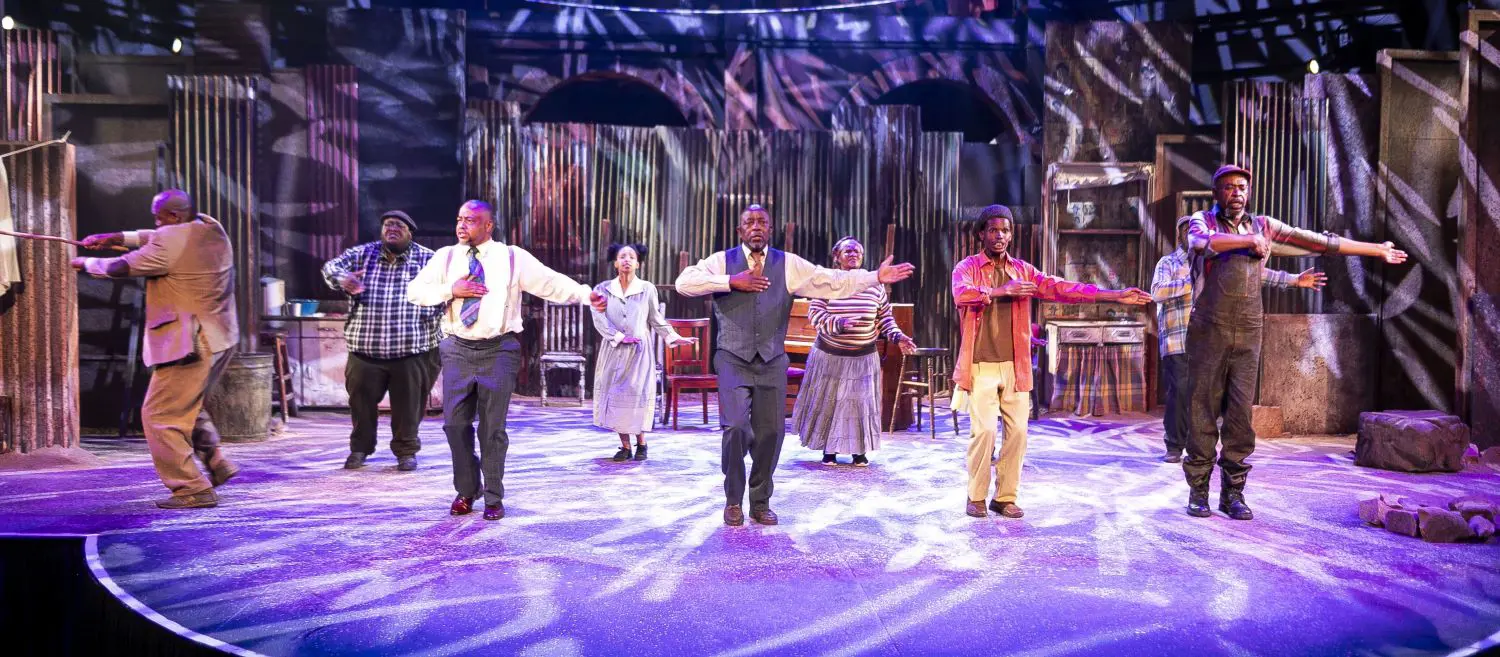
Other infusions followed, from marriage, lineage, to obligation. Each was added as though it might finally balance the mix. None were left long enough to change the body’s response. And so the night moved forward without ever fully committing to one flavour.
That the story arrived in fragments was, at first, forgivable. Marabi was workshopped in Johannesburg by Ari Sitas and the Junction Avenue Theatre Company in 1981, inspired by Modikwe Dikobe’s book, Marabi Dance.
The workshop process privileged accumulation over resolution, allowing the work to hold multiple impulses without forcing them into hierarchy. Looseness thus emerged from a collective workshop culture shaped by political constraint. Marabi participates in that trajectory by embodying plurality, and provisional structure; conditions that defined that moment and now require re-examination when the work is revived.
By the time Marabi was revived in 1995, under the direction of Malcolm Purkey, both the work and the country had crossed a threshold.
The play returned in a moment shaped less by urgency than by remembrance, in the early years of a new democracy eager to consolidate its cultural memory. What had once been a searching, provisional work of collective survival was now being staged as a classic.
The 1995 revival largely preserved the looseness and fragmentation of its workshop origins, choosing continuity over interrogation. In doing so, it carried forward the values of accumulation and plurality without sufficiently reworking them for a changed theatrical and political context.
Which is the question the night kept circling: what do we revive when we revive a classic? The text? The memory? The permission granted by time?
A review of that 1995 staging, written by David le Page and published in the Mail & Guardian, ended with a sober admission: that despite its strengths, Marabi failed to achieve the timelessness it reached for, weighed down by length, indecision, and a lack of surprise. It was not the only response to the production, nor did it close the conversation around the work, but it did name fractures that were visible even then.
Nearly three decades later, those observations still ring true. The play’s weaknesses have not been resolved by time; they have been carried forward, preserved alongside its achievements.
This is the danger of heritage without interrogation. In this current revival, launching the Market Theatre’s year-long 50th anniversary celebrations, the brew was served much as it had been in 1995, carrying forward choices that had already been inherited from the workshop origins of the 1980s.
What began as productive looseness hardened, over time, into form. Not every surviving brew improves by being poured again as it was.
Some demand reworking, some demand distillation, and some, if we are honest, ask to be remembered as ephemera of their moment rather than consumed in new rooms unchanged.
What ultimately carried the night was the work of the actors themselves. The performances were incumbent, often intoxicating, delivered with a commitment that never wavered even when the ground beneath them did.
Mapula Mafole, playing Tiny, held the room with disarming precision. She inhabited childhood; her naïveté felt unperformed, and her fear uncalculated. You could not help but believe her age, and her wonder.
Martha, played by Gabisile Tshabalala carried her role with quiet credibility. Her choices were grounded, her emotional turns legible without exaggeration. You understood why others leaned toward her, why desire and consequence gathered around her presence. She anchored scenes simply by standing inside them.
George, too, was held with remarkable consistency. From his first entrance to his final return, his arc remained intact.
He moved with purpose, his charm and selfishness clearly articulated, his reckoning earned and not merely announced. He was allowed to complete a journey, and Katleho Moloi carried that responsibility with control.
July Mabongo (Sello Sebotsane) and Mma Mabongo (Noma Ngoma) were rendered with lived-in familiarity. Their intimacy felt earned, their disagreements weighted by history. You believed that these two had built a life together, survived nights like this before, and would survive others still. Their relationship grounded the yard when the story itself drifted.
Equally compelling was Mr Makhalima (Alistair Dube). His presence carried the ontological authority of time. His voice, measured and weathered, brought an exceptional weight into the room.
Then there were performances that cracked the night open with laughter. Mr Elocution (Josias Dos Moleele) stole the room each time he entered. His timing was impeccable, his physicality generous, his humour rooted in intelligence.
And Ntebejane (Mpho Molepo) carried an ease and authority that made his presence feel earned, his relationship to the music embodied without recourse to explanation.
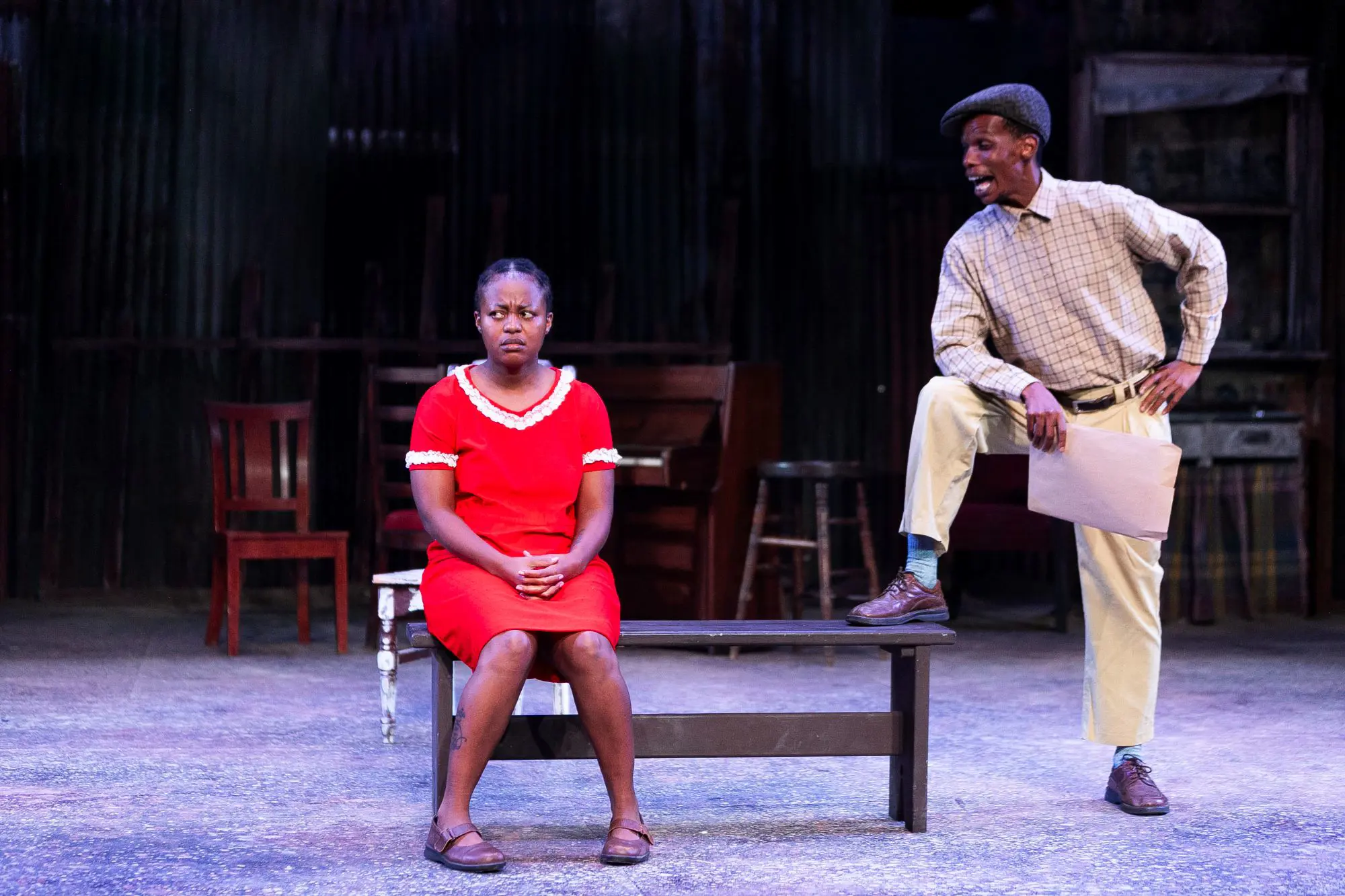
Threading through the night was the presence of Ndala (Peter Mashigo). His appearances were few, but each arrival recalibrated the room. He did not need to assert authority; it travelled with him. There was weight in his stillness, confidence in his economy. You felt the years in his voice.
What made this ensemble particularly moving was its intergenerational breadth. Bodies of different ages shared the stage without hierarchy, without novelty, without apology. Youth moved beside age. Experience sat alongside emergence.
This is rare. This matters. In a theatre economy that often sidelines older performers or confines younger ones to narrow lanes, Marabi insisted that there is space for every age to stand, to speak, to dance. The result was lineage made visible. Theatre remembering itself in real time.
Yet this abundance of performance also revealed the tension at the heart of the evening.
With the story refusing to settle, the body stepped in to compensate.
Performance leaned outward, as if still playing to halls that demanded volume over intimacy.
This was a style born of necessity, shaped in a time when actors had to fight distance, poor acoustics, and vast spaces that swallowed detail. In that context, excess was survival.
But the room we were in no longer required that fight.
In a space that invited closeness, listening, and breath, the inherited style began to obscure as much as it revealed. Quiet moments struggled to land, stillness had little room to work, and emotion arrived fully formed, leaving little space for emotional sediment.
What was gained in energy was sometimes lost in nuance.
The question of invitation then follows: what happens when a style formed under historical pressure is preserved as standard, even when the environment that demanded it has changed?
And yet.
For all this, Marabi remains an exciting night at the theatre. The singing was rich. The dancing was vibrant. The piano by Mduduzi Mtshali was simply beautiful.
The ensemble moved with joy and discipline.
There was humour, warmth, and there was release. If nothing else, the production reminded us of the sheer pleasure of watching skilled performers commit themselves fully to a world, even when that world wavered around them.
If one went expecting a definitive reckoning with marabi, the night fell short. But if one went to be held by song, by movement, by the labour of bodies giving themselves over to performance, there was much to drink in.
Perhaps, what this memory may have required was not repetition, but recollection of its making, the freedom to be tested, adjusted, brought into the present. To remember its origins as experiment and risk, and not be pulled backward by nostalgia alone.
And perhaps that, too, is part of the truth this revival leaves us with: that even when the brew does not quite ferment, the gathering can still be generous; that even when the story refuses to settle, the dance can still carry us, even if only for a while.
Marabi runs at the Market Theatre until 15 Feb 2026.
Vus'umuzi Phakathi is a writer, editor, performer, curator, publicist and poet.
Get the whole picture 💡
Take a look at the topic timeline for all related articles.
Trending News
- 4 hours ago
Search and seizure warrant executed at home of Sergeant Fannie Nkosi
- 4 hours ago
Zuma approaches Constitutional Court in urgent bid to remove Justice Khampepe
- 7 hours ago
Dr Ngobani Makhubu appointed new SARS Commissioner
- 7 hours ago
Minister Ntshavheni blames panic buying for dry pumps, rules out war impact
- 8 hours ago
Construction sector warns fuel hike threatens infrastructure development
- 8 hours ago
Cabinet again assures SA that there's sufficient fuel despite Middle East war
- 10 hours ago
JANE DUTTON EXPLAINS | Spiked: The hidden danger in your drink
- 12 hours ago
EXPLAINER | From battlefield to fuel pump: How war in the Middle-East is hitting Africa
- 12 hours ago
Road traffic managers on high alert over Easter long weekend
- 14 hours ago
Recent fuel price hike heralds dicey journeying for Road Freight Association
- 14 hours ago
Operation Prosper: WC top cop vows to rid province of illegal guns and drugs
- 14 hours ago
DPSA ponders giving provinces more power to expand lifestyle audits for civil servants


More in Lifestyle

2 April 2026 14:45
A deep dive into Nanette Mbili's cathartic creative process

2 April 2026 08:42
WEATHER: Hot Gauteng long weekend ahead as Cape Town braces for showers then sunshine

2 April 2026 08:22
WATCH: Zendaya and Robert Pattinson get real about love, weddings, and emotional messiness in ‘The Drama’