


JUDITH FEBRUARY | How KuGompo City violence exposed South Africa's essence
Judith February
2 April 2026 | 8:59'It’s hard to understand South Africa sometimes, and how quickly things become heated and how inured we have become to the violence which is so much part of our language and landscape,' writes Judith February.
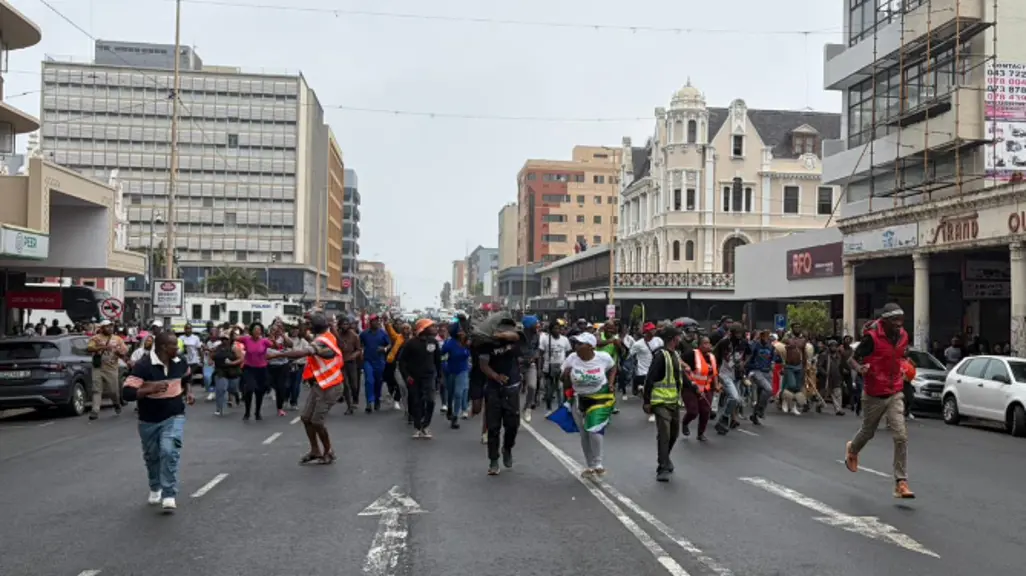
Scores of Kugompo City (formerly East London) residents and traditional leaders on 30 March 2026 are protesting the coronation of a Nigerian king in the city. Picture: Babalo Ndenze/EWN
In a rather under-reported media report, violence flared up in KuGompo City (formerly East London). The name change also tells us where the priorities of the politicians are. As Algoa News recently reported, violence broke out during and after a march by residents in the city.
The report goes on to say, "At the heart of the unrest is a viral video and images circulating on social media showing the so-called crowning of Chief Solomon Ogbonna Eziko as the "Igwe Ndigbo" of KuGompo. Local traditional leaders, including Prince Xhanti Sigcawu, have condemned the move as a 'flagrant violation' of the authority held by the amaRharhabe Kingdom. Sigcawu has called on the government for the immediate deportation of those involved, arguing that foreign nationals cannot be permitted to establish parallel monarchies on South African soil."
It did not take long for the violence to take a xenophobic turn, and, unfortunately, many Somali shopkeepers bore the brunt of the violence and burning. This is not a new phenomenon in South Africa.
Ernesto Nhamuave, a 35-year-old Mozambican, was burned alive during xenophobic violence on the East Rand in May 2008, violence that spread across the country. Of course, many in government refused to call it xenophobia. That seemed and often still seems a step too far.
In 2015, the streets of Durban and surrounding townships were seething with anger and violence as foreigners and locals battled it out. The government finally stepped in to prevent a bloodbath in Durban, yet it was largely reactive. Then, King Goodwill Zwelethini was quoted as saying all foreigners should return to the places they came from. At the time, the government refused to speak out against these blatantly inciteful comments and the king himself blamed the media for misinterpreting what he said. Where have we heard that before?
The environment is ripe for blaming “the other” while competing for scarce resources. We know only too well that violence has always been a part of the South African landscape: physical violence and the violence of language and name-calling.
In countless works of research on local government and conflict in municipalities, the same mantra is heard repeatedly: “They only come when we start to burn things”.
“They” are the politicians who have the power to change things, yet often are unwilling or unable to listen.
It’s hard to understand South Africa sometimes, and how quickly things become heated and how inured we have become to the violence which is so much part of our language and landscape.
This was also the week in which researcher, writer and African scholar, Steven Gruzd was murdered in what has become known as an "express hijacking". His body was found in George Goch hostel on the weekend. The crime appears "random" and five men have appeared in court in connection with the murder. Grudzd was a fine researcher, believed in South Africa and did ground-breaking work on the African Peer Mechanism and NEPAD.
He was a believer in a better country and continent and with his fine mind and gentle manner, he steered that work at the SA Institute for International Affairs at Wits University. Our country is poorer without him and he joins a long and tragic list of South African victims of crime and violence. Unthinking, bloody violence, which is brazen and often goes unpunished.
What we witness each day in the Madlanga Commission revelations is not unrelated to these acts of violence. These are the bitter fruits of the lack of accountability across our institutions and society. In its wake, this lack of accountability leaves trauma, shattered lives and a feeling of hopelessness.
So, when words fail us in the face of the unrelenting challenge of a lack of social cohesion and sweeping violence across our society, Ingrid de Kok’s searing poem, Today I do not love my country, written during the xenophobic violence of 2008, seems apposite. Sometimes the beloved country demands too much of those who live in it, and lament is all there is.
Today I do not love my country
South Africa, May 2008
Today I do not love my country.
It is venal, it is cruel.
Lies are open sewers in the street.
Threats scarify the walls.
Tomorrow I may defend my land
when others X-ray the evidence:
feral shadows, short sharp knives.
I may argue our grievous inheritance.
On Wednesday I may let the winded stars
fall into my lap, breathe air's golden ghee,
smell the sea's salt cellar, run my fingers
along the downy arm of the morning.
I may on Thursday read of a hurt child
given refuge and tended by neighbours,
sing with others the famous forgiving man
who has forgotten who were enemies, who friends.
But today, today, I cannot love my country.
It staggers in the dark, lurches in a ditch.
A curdled mob drives people into pens,
brands them like cattle,
only holds a stranger's hand
to press it into fire,
strings firecrackers through a child,
burns stores and shacks, burns.
Get the whole picture 💡
Take a look at the topic timeline for all related articles.
Trending News
- 4 minutes ago
Cabinet again assures SA that there's sufficient fuel despite Middle East war
- 1 hour ago
JANE DUTTON EXPLAINS | Spiked: The hidden danger in your drink
- 3 hours ago
EXPLAINER | From battlefield to fuel pump: How war in the Middle-East is hitting Africa
- 3 hours ago
Road traffic managers on high alert over Easter long weekend
- 5 hours ago
Recent fuel price hike heralds dicey journeying for Road Freight Association
- 6 hours ago
Operation Prosper: WC top cop vows to rid province of illegal guns and drugs
- 6 hours ago
DPSA ponders giving provinces more power to expand lifestyle audits for civil servants
- 6 hours ago
CoCT urges residents to save water amid declining dam levels
- 6 hours ago
Mitchells Plain sees standoff between some Tafelsig residents and law enforcers
- 6 hours ago
Parly's Agri Portfolio Committee members unhappy about Steenhuisen's behaviour
- 7 hours ago
Gauteng ANC still in talks with MK Party over joining coalition
- 19 hours ago
Lesufi shuffles provincial cabinet to include EFF


