Panyaza Lesufi outlines plan to curb illegal settlements and fix Gauteng services

Kabous Le Roux
29 April 2026 | 11:52Gauteng Premier Panyaza Lesufi warns of worsening service delivery pressures, blaming vandalism, migration and budget strain, while pledging a crackdown on illegal settlements from June.
- 702
- The Clement Manyathela Show
- Panyaza Lesufi
- Gauteng
- Local Government Elections
- Informal settlements
- Service delivery
- Clement Manyathela

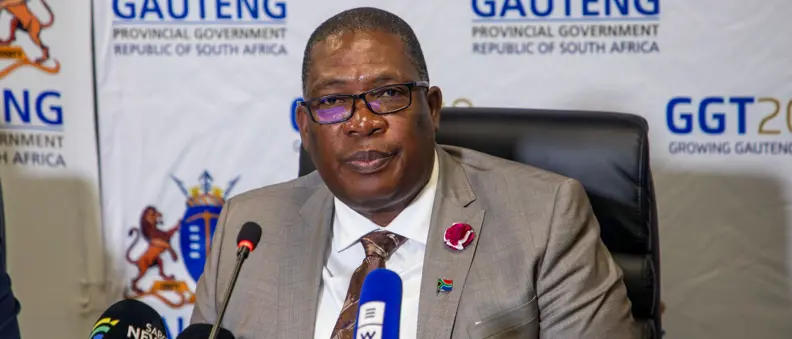
Gauteng Premier Panyaza Lesufi during a press briefing at the Johannesburg Water head office in Newtown, Johannesburg on 11 November 2024. Picture: Jacques Nelles/EWN
— Gauteng Premier Panyaza Lesufi warned that infrastructure sabotage and vandalism are crippling service delivery
— Province to block new informal settlements from 1 June as rapid growth strains resources
— Migration, unemployment and illegal connections are driving rising demand and falling revenue
— Shift to solar power cuts municipal income, worsening budget pressure
— Government prioritising maintenance over new roads to stabilise services
— Coalition deal with EFF secured to pass the budget and avoid service collapse
Gauteng Premier Panyaza Lesufi has warned registered Gauteng voters that service delivery in the province is under growing pressure, driven by infrastructure sabotage, rapid population growth and a shrinking revenue base.
In a wide-ranging interview on 702, Lesufi said the province is battling a “trust deficit” that is being exploited by organised groups targeting public infrastructure.
He described deliberate vandalism as a major threat to basic services.
“If you see the nature of vandalism, you can see it’s not a person looking for cables… It’s people who are experienced.”
‘Organised sabotage’ hitting key infrastructure
Lesufi said attacks have escalated beyond rail and electricity networks to include telecoms, traffic lights and road infrastructure.
He cited incidents where large installations, such as mini substations, were removed entirely.
The province is now relying on technology, law enforcement partnerships and intelligence support to respond.
A joint response team involving police, private security and intelligence services has been deployed, while new tracking systems are being installed in cables and traffic systems.
Scrapyard regulations are also being used to trace stolen infrastructure.
Informal settlements surge, complicating service delivery
Lesufi acknowledged that service delivery has regressed in some areas, partly due to the rapid emergence of informal settlements.
He said new settlements can appear “overnight”, forcing the government to redirect budgets and resources.
“If we have 17 new informal settlements within two weeks… You need to give them water, sanitation and refuse collection.”
The provincial government has now set a firm target to prevent any new informal settlements from forming from 1 June.
Authorities have profiled land invasion networks and say coordinated enforcement will follow.
Revenue losses and rising demand
The Premier said Gauteng’s finances are under pressure from multiple fronts:
— Population growth is increasing the demand for services
— High unemployment is limiting municipal revenue collection
— Illegal connections are causing losses
— Businesses and households shifting to solar power
He warned that the move away from the electricity grid is cutting a key revenue stream for municipalities.
“All your major shopping complexes… factories have migrated to solar. That’s a huge revenue drop.”
Maintenance over new infrastructure
Lesufi defended criticism that services improve during major events like the G20, saying those interventions are costly and difficult to sustain.
He confirmed a policy shift to prioritise maintenance over new projects.
“Let’s not build new roads… when we have not maintained the roads that we have.”
About 15% of the provincial budget is currently allocated to maintenance, which he admitted is insufficient.
The province is also moving to build internal capacity instead of relying on private contractors, including producing its own road repair materials.
Immigration pressures and policy delays
Lesufi said undocumented migration is adding strain to housing, schools and healthcare.
However, he stressed that immigration policy falls under the national government.
He expressed optimism that proposed reforms in a national immigration white paper could clarify responsibilities and close loopholes.
“Our hands are tied… but clarity will come.”
Coalition politics and budget stability
The Premier also defended his decision to appoint an Economic Freedom Fighters (EFF) member as finance MEC, saying it ensured the provincial budget was passed.
He warned that failure to pass the budget would halt salaries for teachers and healthcare workers.
“You could not pay salaries of teachers, doctors… it would have been a catastrophe.”
Lesufi said coalition governance is now a reality and requires compromise to maintain stability.
Voters warned ahead of next election cycle
Lesufi acknowledged declining support for the ANC but argued that governance challenges are often misunderstood or unevenly judged.
He maintained that coalition management and service delivery improvements will be critical in rebuilding support among voters.
For registered Gauteng voters, the interview signals a province under pressure, with government betting on tighter enforcement, infrastructure protection and budget discipline to stabilise services before the next election cycle.
Related news
— Gauteng’s service delivery crisis under fire as opposition questions solutions (Opposition parties say Lesufi has “run out of ideas” to tackle water shortages, crime and informal settlements.)
— Outrage over SOPA spending amid water and service delivery failures (Critics say government priorities are misaligned as millions are spent on events while residents face basic service delivery challenges.
— Lesufi backs military deployment to fight illegal mining and crime (Army deployment aimed at tackling organised crime networks linked to informal settlements and infrastructure damage.
— Displaced informal settlement residents promised relocation (More than 600 residents forced from homes highlight ongoing housing and safety pressures in Gauteng.)
Get the whole picture 💡
Take a look at the topic timeline for all related articles.
Trending News
- 36 minutes ago
Court orders Bellarmine Mugabe's immediate deportation
- 2 hours ago
Mugabe sidesteps imprisonment, Matonhodze gets jail time
- 2 hours ago
Attempts by MPs to quiz Minister Sisisi Tolashe over maladministration claims shut down
- 3 hours ago
Lesufi calls on South Africans to help strengthen illegal immigration legislation
- 4 hours ago
March and March, ActionSA stage march against illegal immigration
- 4 hours ago
KZN doctor (69) netted for allegedly assaulting 4 female patients sexually
- 6 hours ago
March and March protest expected to create congestion in Joburg CBD
- 6 hours ago
ANC SG Mbalula heading to KZN to bolster party's power ahead of polls
- 7 hours ago
Upgrades to SA's ports of entry will ease congestion at border posts: BMA
- 9 hours ago
State wants direct imprisonment for Bellarmine Mugabe and his co-accused
- 9 hours ago
Justice Minister vows to act against any official in her dept fingered at Madlanga Commission
- 9 hours ago
March and March plan to head to the Gauteng Legislature