Slight rise in SA employment numbers driven by surge in new part-time jobs
Paula Luckhoff
11 December 2025 | 18:08The latest Quarterly Employment Statistics from Stats SA reflect an increase in formal non-agricultural jobs in the third quarter, while overall full-time employment declined.

Jobs sign. Pixabay/Ashish_Choudhary
The latest employment numbers are a mixed bag, but do bring some good news.
There was an increase in formal non-agricultural jobs in the third quarter of 2025, while overall full-time employment declined, according to the latest Quarterly Employment Statistics from Statistics South Africa.
Total employment increased by 29,000 or 0.3% quarter-on-quarter from June to September this year.
The industries showing the most growth were community services, trade, and mining; while electricity and transport remained unchanged. Decreases were reported by the business services, manufacturing and construction sectors.
Full-time employment dropped by 21,000 or -0,2% quarter-on-quarter, from 9,426, 000 in June 2025 to 9,405,000 in September.
50 000 new part-time jobs were created, which is a 4,6% quarter-on-quarter increase - from 1,094,000 in June to 1,144,000 in September.
Stephen Grootes talks to economist Professor Miriam Altman, director of Altman Advisory, about this trend.
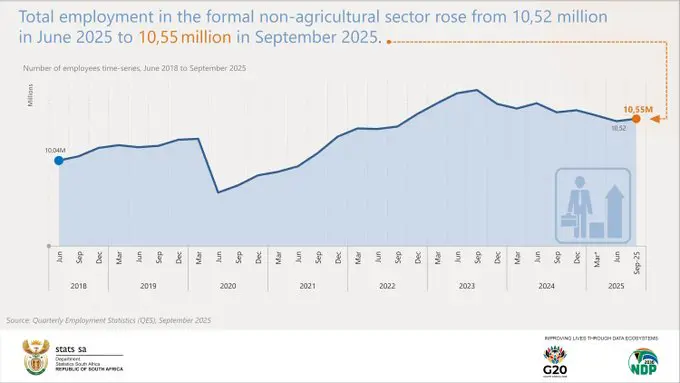
Third quarter employment statistics for 2025- Stats SA
The uptick in part-time jobs is not necessarily a bad thing, remarks Professor Altman.
That is why, at the National Planning Commission, they sometimes talk about a livelihood rather than just a job per se, she explains.
"What you need is enough opportunities that you can assemble a livelihood with, doing possibly multiple things."
This is how things work around the world generally, she says, although it might feel relatively new in South Africa.
Prof. Altman refers to research which reflects that most jobs globally are now found in the services economy, even in strong manufacturing countries like China and Korea.
"Most people, including in the US, are not able to make ends meet because services jobs tend to pay less - I'm not talking here about the high-tech kind of person but the people who are cleaning, doing your nails and washing your hair, working in security and so on."
The issue here is that countries need a system that is supportive, or else this becomes a problem that actually holds a nation back, she says.
Scroll up to the audio player to listen to Prof. Altman's analysis
Get the whole picture 💡
Take a look at the topic timeline for all related articles.
Trending News
- 11 minutes ago
ANC’s Eastern Cape conference called off after legal woes
- 2 hours ago
Eastern Cape ANC to hold another PEC meeting amid conference dilemmas
- 2 hours ago
Joburg DA set to elect new leadership
- 6 hours ago
SANDF deployment meant to help neutralise hotspot areas
- 19 hours ago
Defence minister says SANDF deployment not a permanent fix for gang violence
- Yesterday
KZN top cop’s future uncertain amid national commissioner’s legal woes
- Yesterday
SA’s 'FBI moment': Cachalia defends army deployment
- Yesterday
Tshwane mayor fires Corporate Services MMC following Madlanga Commission findings
- 27/03, 11:55
SANDF to focus on drug kingpins and gang bosses in new strategy
- 27/03, 10:52
ANC’s Eastern Cape elective conference postponed indefinitely
- 27/03, 10:30
Cradock Four inquest: 'Ramaphosa was on my hit list,' says Eugene de Kock
- 27/03, 10:06
ANC's EC elective conference hangs in the balance