


Why the SANDF is withdrawing from DRC after 27 years

Kabous Le Roux
9 February 2026 | 8:55South Africa will pull its remaining SANDF troops from the UN’s MONUSCO mission in the DRC, ending nearly three decades of peacekeeping as the government cites resource realignment.
- 702
- The Clement Manyathela Show
- Clement Manyathela
- South African National Defence Force (SANDF)
- Democratic Republic of Congo (DRC)
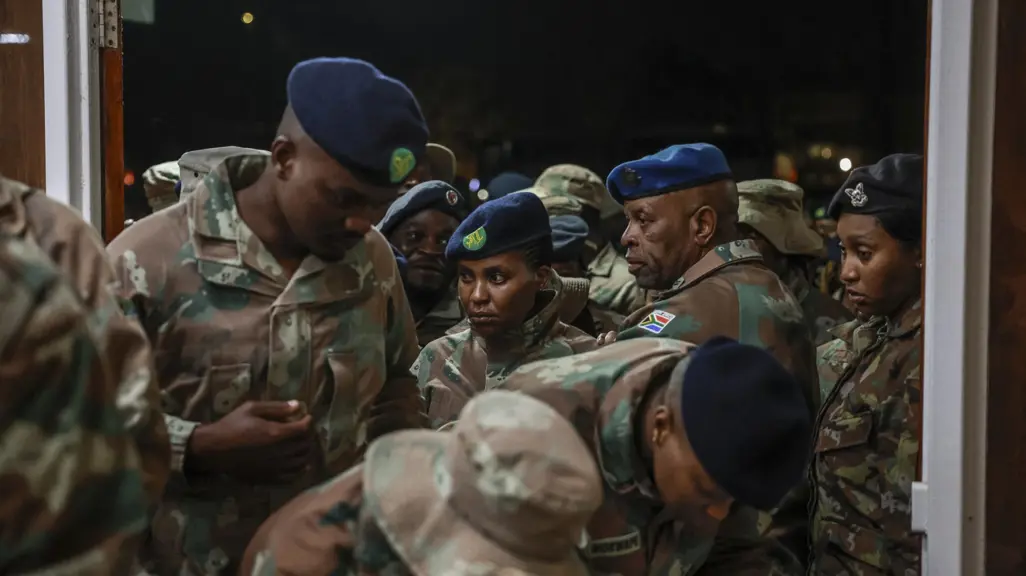
Members of the South African National Defence Force (SANDF) queue to mark a register upon arrival at Tempe Military Base in Bloemfontein on June 14, 2025. (Photo by Phill Magakoe / AFP)
South Africa has announced it will withdraw its troops from the United Nations Organisation Stabilisation Mission in the Democratic Republic of Congo (MONUSCO), ending nearly three decades of continuous peacekeeping involvement in the conflict-ridden country.
The Presidency said the decision was driven by the need to consolidate and realign the resources of the South African National Defence Force (SANDF) after 27 years of support for United Nations peacekeeping efforts in the DRC.
South Africa is currently among the top 10 troop-contributing countries to MONUSCO, with about 700 soldiers deployed in support of the mission’s peacekeeping mandate.
MONUSCO was established by the UN Security Council in 1999 to support the Lusaka Ceasefire Agreement and help stabilise the volatile central African nation.
Difference between MONUSCO and SADC mission
Speaking on 702, SANDF spokesperson Siphiwe Dlamini clarified the distinction between MONUSCO and the SADC Mission in the DRC (SAMIDRC), which was terminated last year.
“The UN mission is called MONUSCO, which is a UN-mandated mission in the DRC to deal with all security issues that are destabilising that region,” Dlamini said.
He explained that SAMIDRC was a regional intervention under the Southern African Development Community (SADC), mainly comprising South Africa, Tanzania and Malawi.
“MONUSCO is much bigger and larger; it has close to 20,000 members from various countries, including South Africa, and it’s purely a United Nations-sanctioned mission, whereas SAMIDRC is a SADC mission,” he said.
While their mandates differed, Dlamini said both missions aimed to restore security and stability in the region.
Funding and cost of deployment
Questions have been raised about the financial implications of South Africa’s long-standing deployment in the DRC, especially amid ongoing budget pressures within the SANDF.
Dlamini said funding arrangements for UN missions differ from regional deployments.
“The UN is responsible for financing the entire mission,” he said. “If we bring in our equipment as we’ve done, the UN then reimburses us in relation to what we’ve brought into the mission.”
He declined to provide specific figures on how much South Africa had spent over the years, noting that financial matters fall under higher offices.
Operational pause and resource pressures
The Presidency said the withdrawal was influenced by the need to address capacity constraints within the SANDF, including financial pressures.
Dlamini described the decision as part of what the military terms an ‘operational pause’.
“Operational pause simply means you stand back and look at how things have been going over a period of time,” he said, adding that it was time to reflect on the country’s long-standing involvement in the DRC.
The withdrawal marks a significant shift in South Africa’s peacekeeping role on the Continent, as the government reassesses military commitments against domestic resource constraints.
For more details, listen to Dlamini using the audio player below:
Get the whole picture 💡
Take a look at the topic timeline for all related articles.
Trending News
- 33 minutes ago
Vuyisile Ncata appointed Eastern Cape’s new police commissioner
- 37 minutes ago
Anticipated national deployment of SANDF set for April
- 1 hour ago
Tshwane takes over water tankers for emergency supply to communities
- 2 hours ago
AG stands by audit findings over Parliament secretary’s salary hike
- 2 hours ago
Protest of 'Nigerian king' coronation at doorstop of nation’s embassy in Pretoria
- 2 hours ago
Law firm fails in bid to overturn Andy Mothibi's appointment as NDPP
- 3 hours ago
Parliament committee probing police graft to suggest extension
- 4 hours ago
Another picket against coronation of 'Nigerian king' expected in Pretoria
- 6 hours ago
WC taxi commuters spared fare increases amid looming fuel hike
- 7 hours ago
6th SA Investment Conference 2026 kicks off in Joburg
- 7 hours ago
KuGompo protest: Traditional leaders claim foreign nationals taking over local communities
- 7 hours ago
SAPS under intense pressure and scrutiny, says Masemola


